





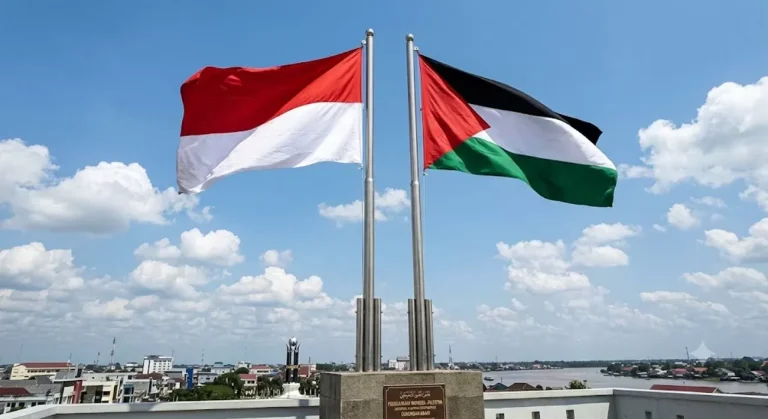

By Imam Yakhsyallah Mansur
بِسْمِ اللَّهِ الرَّحْمَنِ الرَّحِيمِ
“That independence is the right of every nation, and therefore colonialism must be abolished from the face of the earth, for it is not in accordance with humanity and justice.” (First paragraph of the 1945 Constitution Preamble)
These words, penned by the nation’s founders in the preamble of the 1945 Constitution, are far more than just an opening statement. They are a moral declaration and a compass for Indonesia’s national struggle.
Read Also: Remembering the 1969 Al-Aqsa Mosque Arson: A Tragedy That United the Muslim World
They embody the universal principle that every nation has the right to freedom and self-determination, and that all forms of colonialism are a violation of human rights, both personal and collective.
This preamble forms the bedrock of Indonesia’s foreign policy. Indonesia’s first Vice President, Dr. Mohammad Hatta, made it clear that while Indonesia does not align with any power bloc, it cannot stand neutral in the face of injustice and colonialism.
Another key framer of the constitution, Prof. Dr. Soepomo, stated that Indonesia’s national aspirations extend beyond protecting its own people, they also include helping to build a world order based on freedom, lasting peace, and social justice.
In other words, Indonesia’s solidarity with colonized nations is not just a political choice, it’s a constitutional duty that every president must uphold.
Read Also: Abu Ayyub Al Anshari, the Inspirer of Constantinople’s Liberation
The Deep Roots of Palestine-Archipelago Ties
The truth is, the bond between these two nations goes back long before the Republic of Indonesia was even born. Historical records show that as early as the 15th century, when Islam was spreading across the archipelago, spiritual and intellectual connections with Palestine were already part of this land’s story.
The ulama, particularly the Wali Songo regarded Palestine, especially the city of Al-Quds (Jerusalem), as one of the great centers of Islamic civilization, holding a special place in the hearts of Muslims in the archipelago.
We can see this legacy in the figure of Sunan Kudus (Ja’far Shadiq), who spread Islam across Java in the early 16th century. He was known for his deep Islamic knowledge and his strong ties to the scholarly traditions of Palestine.
Read Also: Sa’ad bin Abi Waqqash, the First Islamic Archer and Inhabitant of Heaven
According to the book “Kudus, Purbakala dalam Perjuangan Islam” (Kudus: Antiquities in the Islamic Struggle), Sunan Kudus studied in Baitul Maqdis. Upon his return to Java, he built a mosque he named Al-Quds Mosque, now better known as the “Menara Kudus Mosque.” Even the name “Kudus” itself is believed to come from the Arabic word Al-Quds, one of the names of Jerusalem.
The fact that the name Al-Quds was used right in the heart of Java shows just how deep Palestine’s spiritual influence ran in the archipelago. Baitul Maqdis was seen not just as a holy city, but as a symbol of Islamic civilization that inspired local ulama to spread the faith peacefully while respecting local culture.
And this connection wasn’t limited to Java. At the western edge of the archipelago, the Samudra Pasai Sultanate had already become a major center of Islamic learning, drawing scholars and traders from across the Middle East.
Prof. Dr. Azyumardi Azra, in his book “Jaringan Ulama Timur Tengah dan Kepulauan Nusantara Abad XVII dan XVIII” (The Network of Middle Eastern and Archipelago Scholars in the 17th and 18th Centuries), explains that for centuries, a vast scholarly network connected the archipelago with Makkah, Madinah, Egypt, and Sham (Palestine and surrounding regions).
Read Also: Reading 8th Indonesian Islamic Congress’ Taujihat Through the Lens of Ulul Albab
Over time, this closeness grew into an emotional bond that only became stronger as Indonesia fought for its independence in the mid-20th century.
**Palestine’s Support for Indonesian Independence**
Palestine was among the very first to show solidarity with the newly proclaimed Republic of Indonesia. And this support wasn’t purely political, it was rooted in centuries of shared history and brotherhood.
At a time when Indonesia was struggling to survive against the Dutch campaign to recolonize it, international recognition was desperately needed.
Read Also: KUII For Whom? A Critical Reflection on the 8th Indonesian Muslim Congress
In the middle of that struggle, support came from an unlikely place: Palestine—a land that itself was under threat of colonialism from Britain and its allies.
The Grand Mufti of Palestine, Sheikh Muhammad Amin al-Husseini, used every diplomatic channel he had to introduce Indonesian independence to Arab nations.
Through Arabic Radio broadcasts in the Middle East and direct communication with Arab leaders, he called on Islamic countries to recognize the Republic of Indonesia without delay.
This support was strategically important because, at that time, the Arab world was emerging as a political force on the global stage.
Read Also: Football, Religion, and Solidarity with Palestine
Prof. Susanto Zuhdi, in his studies on early Indonesian diplomacy, notes that Sheikh al-Husseini’s backing gave Indonesia both a moral boost and political momentum.
The Mufti’s call helped speed up recognition of Indonesia by Arab nations which in turn opened the door for Indonesia to gain wider international legitimacy.
Beyond moral support, Indonesia also received concrete help from Palestinian merchants. One name that stands out is Mohammad Ali Taher, a Palestinian businessman who provided substantial financial support for Indonesia’s diplomatic efforts abroad.
Ali Taher’s role is documented in the book “Ali Taher: Pejuang dari Palestina untuk Indonesia” (Ali Taher: A Fighter from Palestine for Indonesia) by senior journalist M. Alwi Shahab.
Read Also: The Sacrifices of Gaza’s Fighters for the Common Good
In return, Indonesian leaders offered both moral and practical support for the Palestinian struggle against Zionist Israeli occupation.
Indonesia’s first President, Ir. Soekarno, repeatedly stressed that Indonesia owes a debt of gratitude to the Palestinian people.
His most famous statement still echoes today: “As long as Palestinian independence has not been handed over to the Palestinians, Indonesia will stand against Israeli colonialism.”
His successor, President Soeharto though often seen as more pragmatic in foreign policy kept Indonesia’s support for Palestine alive. He actively championed the Palestinian cause through the Organization of Islamic Cooperation (OIC) and the Non-Aligned Movement (NAM). He also opened the Palestinian embassy in Indonesia on April 23, 1990.
Read Also: My House is Blocked by the Israeli Yellow Line
The Indonesian government also offered training programs for Palestinian civil servants and backed UN resolutions affirming the Palestinian people’s right to an independent state.
In the post-Soeharto reform era, this consistency continued. President B.J. Habibie reaffirmed Indonesia’s support for a two-state solution based on international law.
President Abdurrahman Wahid made it clear that Palestinian independence is essential for normal relations in the region.
Under President Megawati Soekarnoputri, Indonesia kept up its political support for Palestine at various international forums. Palestinian leaders made state visits to Indonesia and were warmly welcomed by Megawati.
Read Also: Azerbaijan’s Mine Action Efforts: Clearing the Path for Recovery and Development
During Susilo Bambang Yudhoyono’s presidency, Indonesia played an even more active role, offering capacity-building programs for Palestinian civil servants.
And so it continued through Joko Widodo’s administration and into Prabowo Subianto’s. At international forums, Indonesia has consistently voiced strong support for Palestine. Even in their campaign promises, support for Palestine remained a top priority.
Upholding a Historical Mandate in Challenging Times
Under the current Prabowo administration, a number of new developments have sparked heated public debate. Some policies and diplomatic moves have raised questions about Indonesia’s commitment to Palestine.
Read Also: Debunking Zionist Myths and Falsehoods
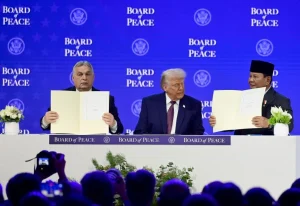
One of the most talked-about issues is Indonesia’s decision to join the Board of Peace (BoP), a body announced by US President Donald Trump to coordinate post-war reconstruction in Gaza.
The Indonesian government sees this as a chance to help rebuild Gaza. But many international relations observers, humanitarian activists, and civil society groups have raised concerns about the BoP’s design and direction.
Critics point out that public documents and statements about the BoP focus heavily on disarming Palestinian fighters and physical rebuilding while barely addressing the root cause: the Israeli occupation itself.
The disarmament agenda has been pushed to the front, while the genocide and brutal Israeli attacks on Gaza have been largely ignored, as if they don’t matter.
Another controversy erupted when President Prabowo Subianto said at the 2025 UN General Assembly: “We must also recognize and guarantee the safety and security of Israel.” It was a statement no Indonesian president had ever made before.
Then there was the case of Gaza’s Health Minister, Dr. Bassem Naim, who was denied entry to Indonesia in March 2026. The official explanation cited administrative and immigration issues. But for many, it felt like a step backward in supporting Palestine.
More recently, the public was shocked by the extradition of a Palestinian scholar, Sheikh Abdul Karim Raed Miqdad, to Cyprus at Interpol’s request.
Many asked: does the Indonesian government trust Interpol that easily? Sheikh Raed is widely respected as a scholar. He had lived in Indonesia for years, ran an Islamic boarding school, and was married to an Indonesian woman.
This has been a painful irony for those who care deeply about Palestine’s struggle for independence, a struggle mandated by Indonesia’s own constitution.
Don’t Let History End with Rhetoric
This is why we need to go back to the history books. Indonesia supports Palestine because it’s a constitutional mandate and because of shared history.
Palestine stood with Indonesia when the republic was still fighting for international recognition. That support is part of our national memory and it shouldn’t be forgotten by today’s generation.
That’s why Indonesia’s relationship with Palestine should never be reduced to mere words, as President Prabowo himself said at the 28th PKB Anniversary in Jakarta on July 23, 2026: “…what we cannot negotiate is our support for the Palestinian struggle for independence.”
But the real test isn’t about strong statements, it’s about following through. It’s about keeping the values of the 1945 Constitution Preamble aligned with the government’s actions on the ground.
History will judge today’s government: whether it stays true to the founders’ vision of fighting for Palestinian independence, or whether it gradually backs down for political convenience and short-term gains.
As long as colonialism continues in Palestine and elsewhere, the call of the 1945 Constitution Preamble will keep echoing. And it must keep being answered.
وَاللَّهُ أَعْلَمُ بِالصَّوَاب
Mi’raj News Agency (MINA)














![Security forces take measures as protesters gather outside Woolwich Crown Court to show support for a group known as the “Filton 24,” whose trial is ongoing over a protest at an Israeli defense company’s facility in Bristol in 2024 in London, United Kingdom on June 12, 2026. [Aysu Biçer – Anadolu Agency]](https://en.minanews.net/wp-content/uploads/2026/06/Screenshot_2026-06-13-17-48-18-76_40deb401b9ffe8e1df2f1cc5ba480b12-300x194.jpg)




 Mina Indonesia
 Mina Arabic
 Mina Sport