





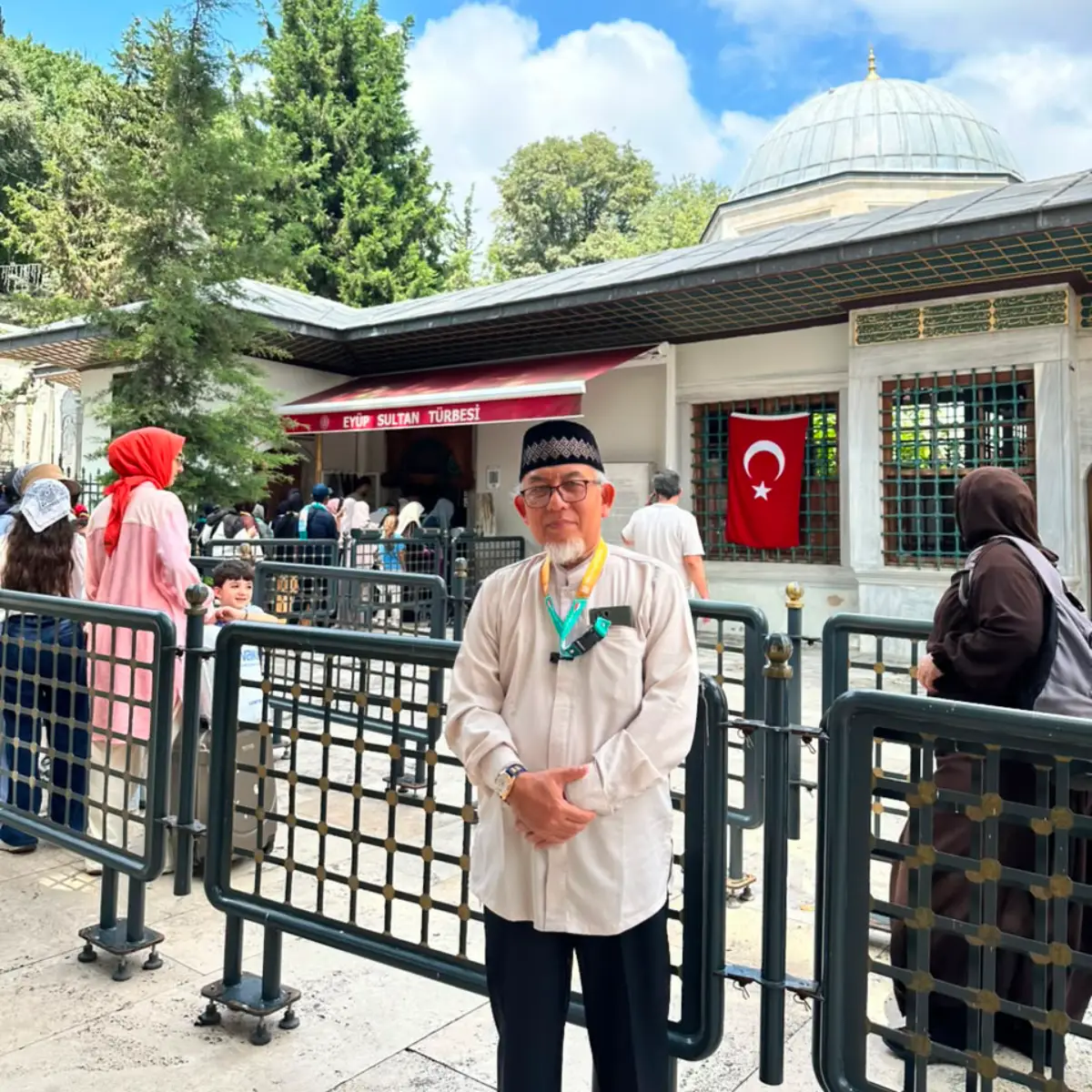

By Imaam Yakhsyallah Mansur
This article was written on a hill near the tomb of Abu Ayyub Al Anshari, Istanbul, Turkey
The Prophet Muhammad, peace be upon him, said in a narration from Bishr al-Ghanawi:
**لَتُفْتَحَنَّ الْقُسْطَنْطِينِيَّةُ، وَلَنِعْمَ الْأَمِيرُ أَمِيرُهَا، وَلَنِعْمَ الْجَيْشُ ذَلِكَ الْجَيْشُ** (رواه الحاكم)
Read Also: Remembering the 1969 Al-Aqsa Mosque Arson: A Tragedy That United the Muslim World
“Verily, Constantinople shall be conquered. What an excellent leader its leader will be, and what an excellent army that army will be.” (Narrated by Al-Hakim)
That morning, Istanbul appeared as a city turning the pages of its history. From a hill not far from the tomb complex of Abu Ayyub Al Anshari, the gaze swept freely over the city now known as one of the world’s centers of civilization.
Down below, life moved as usual, vehicles passed, ships sailed along the Bosphorus Strait that divides two continents, while mosque minarets stood among modern buildings.
Behind today’s bustling Istanbul lies the trace of a man who lived more than thirteen centuries ago and left a story that seems never to end.
Read Also: Sa’ad bin Abi Waqqash, the First Islamic Archer and Inhabitant of Heaven
The name is Abu Ayyub Al Anshari, may Allah be pleased with him. He was neither a sultan nor a commander. In fact, he passed away before that dream was realized. Yet that is precisely where the uniqueness of his story lies. He came to Constantinople at an advanced age, spent the remainder of his life on an expedition, and was buried near the city that had not yet been conquered.
Eight centuries later, a young man named Muhammad Al-Fatih came to the same city and succeeded in opening the gates of Constantinople. Between these two events, separated by hundreds of years, lies a red thread connecting vision, sacrifice, and victory that ultimately arrived through the next generation.
The Story of Abu Ayyub in Madinah
Abu Ayyub was a man from Yathrib named Khalid bin Zaid bin Kulaib Al-Anshari Al-Khazraji. He belonged to Bani Najjar, one of the Khazraj tribes in Madinah.
Read Also: Reading 8th Indonesian Islamic Congress’ Taujihat Through the Lens of Ulul Albab
He was among the Ansar who pledged allegiance to the Prophet Muhammad, peace be upon him, in the second Pledge of Aqabah. On that historic night, the Muslims from Yathrib declared their faith and their willingness to protect him if he migrated to their city.
Abu Ayyub proved that promise in his life. When the Prophet Muhammad, peace be upon him, migrated and arrived in Madinah, Abu Ayyub’s home became his place of residence during the early days before the construction of the Prophet’s Mosque and his dwelling were completed.
That simple home surely held irreplaceable memories for Abu Ayyub. There he could see the Prophet closely, hear his words, observe his habits, and directly experience how love for the Messenger was embodied in a Companion’s life.
From Madinah, Abu Ayyub’s struggle continued to develop. He accompanied the Prophet in various battles and participated in the Battles of Badr, Uhud, and numerous other expeditions. He witnessed how the small community built in Madinah grew into a force that transformed the face of the Arabian Peninsula.
Read Also: Once Again, Indonesia-Palestine Relations
After the Prophet’s passing, Abu Ayyub lived through the leadership of Abu Bakr, Umar, and Uthman, may Allah be pleased with them, when Islamic territory continued to expand beyond Arabia. The changing times did not cause him to withdraw from the life of the community. He continued to take part in the struggles of the Muslims.
In the book of Al-Ishabah fi Tamyiz al-Sahabah, Ibn Hajar al-Asqalani, may Allah have mercy on him, recorded various narrations about Abu Ayyub’s life. His journey reveals a Companion who possessed unwavering determination to continue benefiting the faith and the community.
The Long Journey to Constantinople
That spirit eventually led him on a long journey from Madinah to Byzantine territory. During the rule of Muawiyah bin Abi Sufyan, the Muslims undertook an expedition to Constantinople, and Abu Ayyub was among them, though he was no longer young, 80 years old.
Read Also: KUII For Whom? A Critical Reflection on the 8th Indonesian Muslim Congress
Constantinople at that time was the capital of the Byzantine Empire, a city with extremely strong defensive walls and a strategic position that made it one of the world’s centers of trade and politics. Reaching it required the army to travel a long distance and face numerous challenges.
For Abu Ayyub, this journey was not merely a military expedition. Constantinople was part of the great vision of the community that had grown since the time of the Prophet Muhammad, peace be upon him. He believed in the tidings of the city’s conquest and wanted to take part in the struggle toward that vision.
However, fate ultimately determined his destiny. When he fell ill and his end approached, Abu Ayyub conveyed a message that he be carried as close as possible to Constantinople. If the army could still move, they should carry his body farther; if not, then he should be buried where they had reached.
That message shows how a vision had become part of his life’s journey until his final breath. Abu Ayyub then passed away and was buried near Constantinople.
Read Also: Football, Religion, and Solidarity with Palestine
He did not see the city conquered. He did not witness the banner of victory raised over its walls. But history later carried his story into a new chapter.
Muhammad Al-Fatih Conquers Constantinople
Time passed, generations changed, while the Byzantine Empire remained. The vision of Constantinople’s conquest was passed from one Muslim generation to the next.
Until 1453, a young man named Muhammad Al-Fatih led the Ottoman army to conquer the city. Though young in age, his preparation was mature. With knowledge, strategy, courage, and conviction, his army breached the city’s defenses, which for centuries had been known as extremely difficult to overcome.
Read Also: The Sacrifices of Gaza’s Fighters for the Common Good
After Constantinople was conquered, Muhammad Al-Fatih’s teacher, Shaykh Aqshamsuddin, pointed out the location of Abu Ayyub’s grave. The area later developed into one of Istanbul’s important spiritual centers, known as Eyüp Sultan.
Muhammad Al-Fatih and Abu Ayyub lived in different eras. They never met, separated by nearly eight centuries. Yet both seemed brought together by the same vision.
Abu Ayyub came to Constantinople as a Companion of the Prophet who ended his life near the city. Muhammad Al-Fatih came as a young leader who conquered it.
Thus, Muhammad Al-Fatih’s victory in 1453 does not stand as an event separate from previous history. It is one of the peaks of a long journey traversed by many Muslim generations, including those who struggled without seeing the final result.
Read Also: My House is Blocked by the Israeli Yellow Line
A Legacy That Does Not End at a Grave
Abu Ayyub’s legacy in Istanbul did not stop with the expedition to Constantinople. Around his grave, various educational and social facilities developed, such as madrasas, libraries, imarets (soup kitchens), and community service centers.
Thus, Abu Ayyub’s name is remembered not only through his struggle but also through a civilizational tradition that connects worship, knowledge, and service to the community.
The Eyüp district then held a special place in Ottoman history. Abu Ayyub’s grave became one of the important symbols of Ottoman religious and political life. The sultans even had a tradition of performing the sword-girding ceremony in Eyüp after ascending the throne.
Read Also: Azerbaijan’s Mine Action Efforts: Clearing the Path for Recovery and Development
So when someone comes to the Eyüp Sultan complex today, what they find is not merely an old grave. There lies a historical space that brings together da’wah, knowledge, worship, struggle, and civilization.
There we can understand that a figure’s influence is not always measured by how often their name is mentioned or how much power they once held. Abu Ayyub left an influence, primarily through his exemplary life.
Lessons for Today’s Generation
Ibn Hajar al-Asqalani, when preserving Abu Ayyub’s life journey in *Al-Ishabah fi Tamyiz al-Sahabah*, shows us a Companion who continued to take part in the struggle well into old age.
Read Also: Debunking Zionist Myths and Falsehoods
From this story, the present generation can learn that limitations of age and ability should not be reasons to stop being beneficial. Every person has a space for service according to the abilities Allah has granted them.
Abu Ayyub’s message lies in a long expression. That message is read from his life’s journey: he opened his home for the Prophet, contributed his energy to da’wah, joined various struggles, and then traveled far to Constantinople.
His story also teaches that the fruit of a struggle does not always have to be enjoyed by the one who started it. A person may only be given the opportunity to plant, while Allah gives the next generation the opportunity to continue and enjoy the fruits of their struggle.
Such lessons feel increasingly important in an era when success is often measured by quick results. Abu Ayyub demonstrates that the value of service does not depend on whether one witnessed its results or not.
Abu Ayyub al-Ansari did not bring victory back to his homeland. He left something longer-lived than a victory: an example of loyalty to the struggle until the very end of life.
Perhaps we will never see the fruit of the struggle we undertake today. Yet, like Abu Ayyub, we can leave seeds that will one day grow in the hands of the generation after us.
When one day we are no longer in this world, what remains is not how much success we enjoyed, but what traces of goodness we left behind for those who come after us to continue.
Abu Ayyub left that trace. He passed away before seeing Constantinople conquered, but his name lives on as a reminder that a vision pursued with faith never dies.
وَاللَّهُ أَعْلَمُ بِالصَّوَاب (And Allah knows best).[]
Mi’raj News Agency (MINA)























 Mina Indonesia
 Mina Arabic
 Mina Sport