





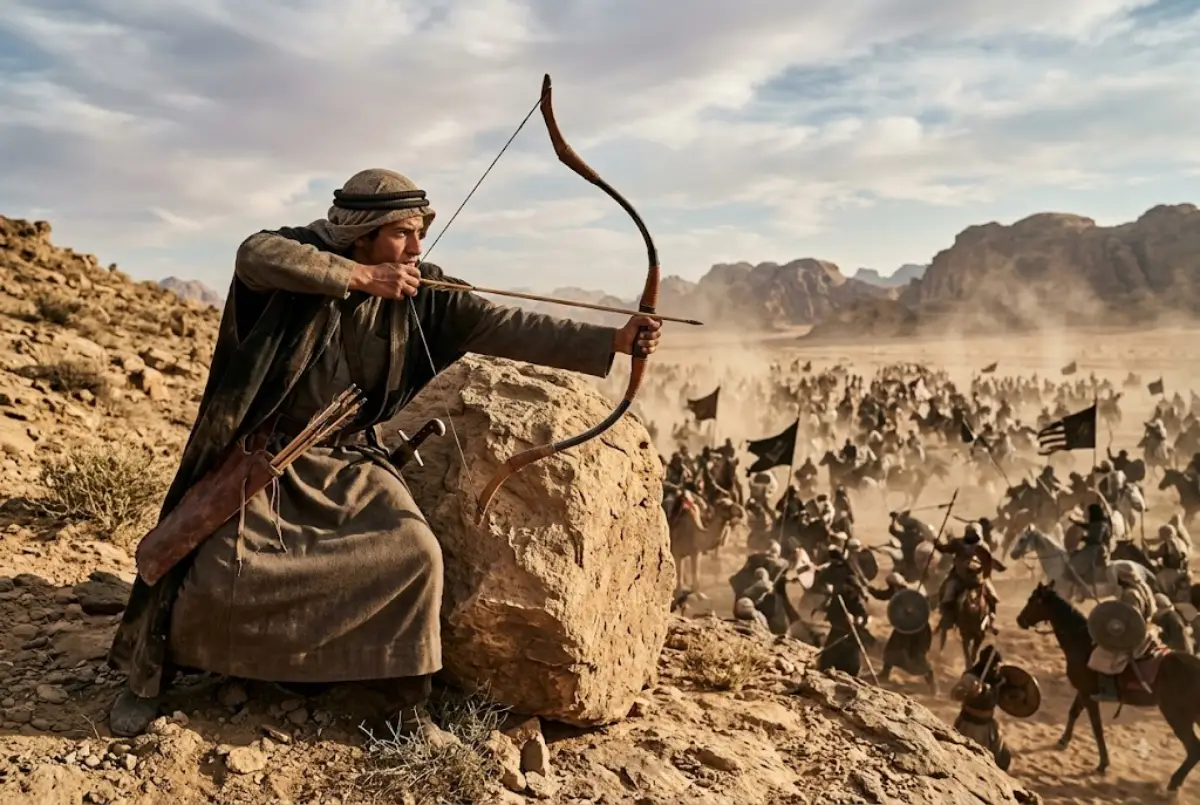

Sa‘d bin Abi Waqqas (may Allah be pleased with him) was a Companion of the Prophet Muhammad (peace and blessings be upon him) whose name is immortalized as the first archer to fight in the cause of Allah, the commander of the Battle of al-Qadisiyyah, and one of al-‘Ashrah al-Mubashshirin bil-Jannah—the ten Companions guaranteed entry into Paradise.
Sa‘d was also among the Ahl al-Shura (the Consultative Council), the six Companions appointed by Umar bin al-Khattab (may Allah be pleased with him) to assist him in his duties as Caliph. His life story reveals a rare blend of steadfast faith, military prowess, detachment from worldly power, and spiritual depth.
Early Conversion to Islam
Sa‘d bin Abi Waqqas embraced Islam at the age of 17. He belonged to the very first generation to accept the faith. He himself recounted with full awareness:
Read Also: Meaning Behind Palestinian Ambassador’s Kiss on Imaam Yakhsyallah’s Forehead
مَا أَسْلَمَ أَحَدٌ إِلَّا فِي الْيَوْمِ الَّذِي أَسْلَمْتُ فِيهِ، وَلَقَدْ مَكَثْتُ سَبْعَةَ أَيَّامٍ وَإِنِّي لَثُلُثُ الْإِسْلَامِ
“No one embraced Islam before the day I embraced it. Indeed, for seven days, I constituted one-third of Islam.” (Narrated by al-Bukhari)
This statement underscores just how few Muslims there were during the initial phase of the call to Islam.
Sa‘d hailed from the Banu Zuhrah, a clan that shared a maternal kinship tie with the Prophet (peace and blessings be upon him). Because of this, the Messenger of Allah once said regarding him:
هَذَا خَالِي، فَلْيُرِنِي امْرُؤٌ خَالَهُ
“This is my maternal uncle; so let any man show me his maternal uncle.” (Narrated by al-Ḥakim in al-Mustadrak)
Read Also: Remembering the 1969 Al-Aqsa Mosque Arson: A Tragedy That United the Muslim World
This expression demonstrates the personal regard and emotional closeness the Prophet (peace and blessings be upon him) held for Sa‘ad.
Steadfast Faith and the Revelation of a Quranic Verse
Sa‘ad’s conversion to Islam met with fierce opposition from his mother, who even went on a hunger strike. Yet, Sa‘ad remained steadfast in *Tawhid* (monotheism). With great firmness and proper etiquette, he said:
يَا أُمَّهْ، وَاللَّهِ لَوْ كَانَ لَكِ مِائَةُ نَفْسٍ، فَخَرَجَتْ نَفْسًا نَفْسًا، مَا تَرَكْتُ دِينِي
“O Mother, by Allah, even if you had a hundred lives and they departed one by one, I would not abandon my religion.” (Narrated by Muslim)
Read Also: Abu Ayyub Al Anshari, the Inspirer of Constantinople’s Liberation
This event was the occasion for the revelation of the words of Allah (Glorified and Exalted be He):
وَوَصَّيْنَا الْاِنْسَانَ بِوَالِدَيْهِ حُسْنًاۗ وَاِنْ جَاهَدٰكَ لِتُشْرِكَ بِيْ مَا لَيْسَ لَكَ بِهٖ عِلْمٌ فَلَا تُطِعْهُمَاۗ اِلَيَّ مَرْجِعُكُمْ فَاُنَبِّئُكُمْ بِمَا كُنْتُمْ تَعْمَلُوْنَ ٨
“We have enjoined upon man goodness toward his parents. But if they strive to make you associate with Me that of which you have no knowledge, do not obey them. To Me is your return, and I will inform you of what you used to do.” (QS. al-Ankabut: 8)
This verse affirms a sublime principle of Islam: showing dutifulness to parents without compromising Tawhid.
The First Archer in Islam
Read Also: Reading 8th Indonesian Islamic Congress’ Taujihat Through the Lens of Ulul Albab
Sa‘ad was renowned as an exceptional archer. He was the first person to shoot an arrow in the cause of Allah. In many battles, the Prophet (peace and blessings of Allah be upon him) placed his full trust in him.
One night, the Messenger of Allah (peace and blessings of Allah be upon him) felt uneasy and said:
لَيْتَ رَجُلًا صَالِحًا مِنْ أَصْحَابِي يَحْرُسُنِي اللَّيْلَةَ
“If only a righteous companion of mine would guard me tonight.”
Shortly thereafter, Sa‘ad arrived, and the Messenger of Allah (peace and blessings of Allah be upon him) slept peacefully. Aisha said:
Read Also: Once Again, Indonesia-Palestine Relations
فَنَامَ رَسُولُ اللَّهِ ﷺ حَتَّى سَمِعْتُ غَطِيطَهُ
“So the Messenger of Allah (peace and blessings of Allah be upon him) slept until I heard his snoring.” (Narrated by Al-Bukhari)
He was also among the companions whose prayers were answered, as evidenced during the Battle of Badr when the Prophet (peace and blessings of Allah be upon him) prayed:
اللَّهُمَّ اسْتَجِبْ لِسَعْدٍ
“O Allah, answer Sa‘ad’s prayer.” (Narrated by At-Tirmidhi)
Commander of the Battle of Qadisiyah and Conqueror of Persia
Read Also: KUII For Whom? A Critical Reflection on the 8th Indonesian Muslim Congress
The pinnacle of Sa‘ad’s strategic role was seen in the Battle of Qadisiyah, a decisive conflict against the Persian Empire. Umar bin al-Khattab appointed Sa‘ad as commander, even though he was gravely ill at the time and led the forces from his bed.
Over four days of fighting, the Muslim army achieved a great victory. This triumph paved the way for the conquest of Al-Mada’in (the Persian capital) and the collapse of the symbol of the Kisra’s (Persian Emperor’s) power.
The crossing of the Tigris River without boats—an event witnessed by the enemy with astonishment—stands as one of the epic moments in Islamic military history.
Zuhud in the Time of Fitnah
Read Also: Football, Religion, and Solidarity with Palestine
Even though he has strong legitimacy to rule, Sa’ad chose to stay away from political conflict during the fitnah period. He said firmly: “I will not fight until you give me a sword that can differentiate between believers and infidels.”
This attitude shows the depth of fiqh and extraordinary caution in protecting the blood of Muslims.
Regarding his asceticism, Sa’ad narrated the words of the Prophet sallallaahu ‘Alaihi Wasallam:
إِنَّ اللَّهَ يُحِبُّ الْعَبْدَ التَّقِيَّ، الْغَنِيَّ، الْخَفِيَّ
“Indeed, Allah loves servants who are pious, content, and unknown.” (HR. Muslim)
Read Also: The Sacrifices of Gaza’s Fighters for the Common Good
Residents of Heaven
At the end of his life, Sa’ad died with full confidence in Allah’s promises. He ordered that he be shrouded in the robe he had worn at the Battle of Badr. His son, Mus’ab, narrated that his father said: “Do not weep. Indeed, I am a resident of heaven.” (Ibn Sa’ad, ath-Thabaqat al-Kubra)
Sa’ad bin Abi Waqqash died in 674 AD in al-‘Aqīq and was buried in Baqi’, leaving behind traces as a monotheistic soldier, conquering commander, and zahid who was free from world ambitions. []
Mi’raj News Agency (MINA)



















 Mina Indonesia
 Mina Arabic
 Mina Sport
