







By Qasem Walees El-Farra, writer in Gaza
EVERY week I visit my aunt Nada, who lives in downtown Khan Younis, in southern Gaza.
Her small home is damaged but livable, with a bathroom, a modest kitchen setup and a bedroom down the narrow hall, with two mattresses pushed against the wall. I sometimes help my cousin Nour, 14, with her math and English, and I also sit with my cousin Salah, 11, who has a cognitive disability.
Their father was killed by an Israeli airstrike in the early months of the genocide, so I run errands for the family and help in whatever way I can, with repairs and whatnot.
Read Also: Remembering the 1969 Al-Aqsa Mosque Arson: A Tragedy That United the Muslim World
My aunt’s family and mine spent most of the last year living together in the same tent, and during that time I bonded with Salah, who was very close with his father. He now frequently scrolls through his father’s phone, crying a little as he looks at photos and videos.
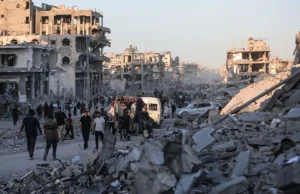
After my visits, I roam the streets of Khan Younis and, on these walks, I have noticed that, since the so-called ceasefire of October 2025, people are returning to the city and to their homes, or rather what remains of them. Many have erected tents on the sites where their homes used to be, since so few were left standing after relentless Israeli attacks.
Khan Younis is a family-based community. Every big family resides in a certain part of the city, so it’s easy to notice the return of many people. Major streets like al-Bahr are also starting to wake up and are once again filled with shops and street vendors, though not quite to the extent that they used to be.
What once distinguished al-Bahr street for me was the feeling of chaos and randomness in all the shops and stalls. Each shop would have its own music blaring, and during Eid, spice merchants would draw unique illustrations on their spice boxes.
Read Also: Abu Ayyub Al Anshari, the Inspirer of Constantinople’s Liberation
Al-Bahr street, though more lively than it was a year ago, is not like that now. One wonders if it will ever be like that again, especially since downtown Khan Younis is a little less than a kilometer from the Israeli “yellow line,” behind which Israel has razed Palestinian homes and constructed military infrastructure. The yellow line is an attempt to claim vast swaths of Palestinian land.
Israel has seized about 60 percent of Gaza so far, a percentage set to rise, according to Israel’s prime minister, Benjamin Netanyahu, who wants to take 70 percent.
This yellow line is what prevents our complete return to our city, especially for those of us, like myself, who reside on the eastern side of Khan Younis.
My obliterated neighborhood and obliterated home are still under occupation by Israeli forces. The nearest I can get to my home is the Abu Hmeid roundabout, about a kilometer west of Salah al-Din street, which is practically where the yellow line begins.
Read Also: Sa’ad bin Abi Waqqash, the First Islamic Archer and Inhabitant of Heaven
Taking a step eastward from that point can be deadly. Israel shot dead two of my neighbors – Mohammad Abdul Hamid al-Farra, 23, in February 2026, and Khamis al-Qassas, 37, in April 2026 – as they tried to check on our neighborhood from afar.
When I approached the yellow line this past May, I could see the Israeli military base that is under construction at the Bani Suhaila roundabout. I saw huge sand berms that surround the base, as well as the security fences and the military guard tower.
Looking eastward from the Abu Hmeid roundabout, toward my former neighborhood, the area looks symmetrical in its ruined state. It’s as if you placed a mirror in front of another mirror, and what you get is an endless repetition of the same picture.
What can one do from this position, so close to your home yet unable to step toward it? How can anyone remain sane after seeing their past crushed under Israeli bulldozers? []
Read Also: Reading 8th Indonesian Islamic Congress’ Taujihat Through the Lens of Ulul Albab
Source The Electronic Intifada
Mi’raj News Agency (MINA)
Read Also: Once Again, Indonesia-Palestine Relations




 Mina Indonesia
 Mina Arabic
 Mina Sport