






The United States often positions itself as a beacon of modern civilization, building its national identity and moral legitimacy in global politics on liberal democracy, human rights, the rule of law, and individual freedom.
However, when these values clash with the actual exercise of power, a fundamental question arises: can America still claim to be a civilized nation, or has it transformed into a hegemonic force that has lost its ethical compass?
This question becomes increasingly relevant during Donald Trump’s leadership. Under the “America First” rhetoric, US foreign policy has shown tendencies toward unilateralism, coercion, and a frequent disregard for international norms. Other countries are no longer treated as equal partners but as objects of pressure, whether through economic sanctions, trade wars, military threats, or political coercion. In this context, the international arena becomes not a place for cooperation, but a field of domination.
From an international relations perspective, such actions can be analyzed through the framework of hegemony. Antonio Gramsci emphasized that hegemony is not merely military or economic domination, but also the ability to shape the thinking, values, and perceptions of other actors. Trump, often seen as anti-intellectual, actually displays a crude hegemonic practice: forcing compliance not through consensus, but through direct threat.
Read Also: Remembering the 1969 Al-Aqsa Mosque Arson: A Tragedy That United the Muslim World
America’s withdrawal from various international agreements, from climate accords to nuclear deals and multilateral forums that demonstrates a rejection of the rules-based global order. Ironically, that very order was largely built and long promoted by the US itself. When the rules are no longer advantageous, they are abandoned. This is not the behavior of a civilized state, but of a powerful nation that refuses to be constrained.
Here, criticism should be directed not only at Trump as an individual but at American society collectively. Democracy does not stop at the electoral process. It demands critical participation, public oversight, and the moral courage to oppose deviant power. America’s own history records the significant role of students, academics, and intellectuals in opposing the Vietnam War, racial segregation, and structural injustice.
Yet, in the Trump era, these voices seem to have weakened. Domestic polarization, political pragmatism, and public fatigue appear to be diminishing the critical power of civil society. When a president acts arbitrarily on the global stage, the question is not only “what is Trump doing?” but also “why is this allowed?”
From a political ethics perspective, public silence in the face of structural violence carried out in the name of the state constitutes a moral failure. Hannah Arendt called it the “banality of evil”: evil that occurs not because of extraordinary malice, but because of obedience, apathy, and the normalization of deviant power.
Read Also: Abu Ayyub Al Anshari, the Inspirer of Constantinople’s Liberation
America’s coercive policies never have a neutral impact. Developing countries often become the most visible victims. Economic sanctions hit civilians, not political elites. Trade wars shake global economic stability. Political and military interventions create prolonged conflicts. The world is forced to adjust to the interests of a single nation.
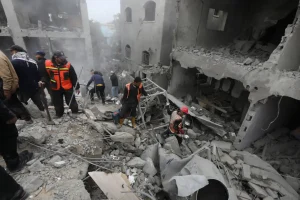
In the context of the Middle East conflict, particularly in Gaza, this pattern is evident again. The discourse on conflict resolution is often framed from the perspective of major powers, not from the needs and rights of the people directly affected. Other countries are invited to “participate” in schemes designed without equality of position. Such participation resembles political legitimization more than a sincere effort to build peace.
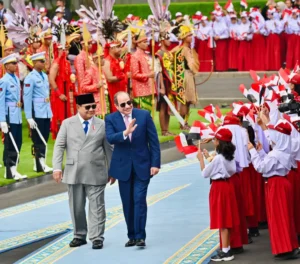
At this point, reflection must also be directed at countries outside America, including developing nations that often claim to pursue an independent and active foreign policy. When a country’s leader readily welcomes an invitation from a major power, even on sensitive issues like Gaza, without a firm critical stance, questions arise about moral and political independence.
Involvement in international forums should aim to champion justice and humanity, not merely to boost image or closeness to the global centers of power. If a nation with a history of supporting Palestinian independence instead appears accommodating to an agenda clearly biased, then “independent and active” risks becoming “submissive and compliant.”
Read Also: Sa’ad bin Abi Waqqash, the First Islamic Archer and Inhabitant of Heaven
This critique need not be stated vulgarly. It can be read as a warning that proximity to hegemonic power is often paid for with compromises on values.
The world does not need an America that thinks it is always right, nor does it need other leaders competing for the favor of major powers. The world needs moral leadership, from both powerful and developing nations. Global peace is only possible if power is constrained by ethics, and sovereignty is respected without coercion.
The question “I want to ask you, Americans” is ultimately not just a provocation, but an invitation to reflect. Democracy without moral responsibility is merely an empty procedure. Power without ethics is a threat to humanity.
If America still wants to claim itself as a civilized nation, then its educated class must speak up, its students must be critical, and its intellectuals must dare to challenge the arrogance of power. If not, then history will record not only the arbitrariness of one president, but the failure of a nation to uphold the very values it prides itself on.
Read Also: Reading 8th Indonesian Islamic Congress’ Taujihat Through the Lens of Ulul Albab
And for other nations, including us, the question is just as crucial: do we stand for peace and justice, or do we merely seek a safe place in the shadow of power?[]
Mi’raj News Agency (MINA)
Read Also: Once Again, Indonesia-Palestine Relations


















 Mina Indonesia
 Mina Arabic
 Mina Sport
