







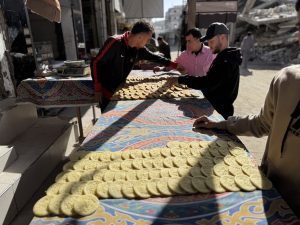
Gaza, MINA – With the holy month of Ramadan set to begin next week, Palestinians across the Gaza Strip are preparing to welcome the fasting season by reviving the age-old tradition of preparing Qatayef over makeshift wood-fired stoves.
In Gaza, the arrival of the holy month isn’t just measured by the calendar; it is felt through the aroma of this traditional Palestinian dessert, which has returned to the markets after two years of devastating conflict.
At the “Rafah Garage Market” in the southern city of Khan Younis, a place once teeming with shoppers before the Israeli Genocide, shopkeepers are struggling to breathe life back into their businesses. Among them are the Qatayef makers, who have once again lit their fires amidst the rubble.
Working in the shadow of widespread destruction and near areas still under Israeli occupation to the east of the city, these vendors persevere under gruelling conditions, including severe shortages of fuel and cooking gas.
Read Also: Palestinians Suffer Further as WFP Cuts Aid to 700,000 People in Gaza and the West Bank
A Deeply Rooted Tradition
With over 20 years of experience, Salim Al-Bayouk known in the market as the “King of Qatayef” continues to craft the dessert by hand, despite limited resources and a scarcity of raw materials. The 54-year-old told Anadolu that he originally started his business in Rafah before relocating to Khan Younis following the Israeli occupation of his home city. He remains determined to keep his business alive regardless of the circumstances.
Qatayef is regarded as the “Queen of Ramadan desserts” among Palestinians, cherished for its simplicity and affordability. The dish consists of small pancakes stuffed with nuts, cheese, or dates, which are then baked or fried and soaked in sweet syrup.
Al-Bayouk explained that during a typical Ramadan, his work requires roughly 25kg of cooking gas daily. However, the chronic supply shortage has forced him to rely entirely on firewood.
Read Also: Israeli Attacks Kill Two Palestinians, Including 10-Year-Old Boy, in Gaza
Since the ceasefire agreement took effect in October 2025, Israel has allowed only small quantities of cooking gas into Gaza, while the region requires 20 gas trucks daily, according to local officials.
Despite the shortages and rising operational costs, Palestinians remain insistent on continuing their work, resisting displacement and clinging to Ramadan traditions that they refuse to let vanish from their city.
Al-Bayouk has lowered his price to 10 shekels (approximately $3) per kilogram and provides seasonal employment for 10 to 15 workers, emphasising his commitment to staying put despite his damaged shop and reliance on emergency repairs.
Across the Gaza Strip, hundreds of others are practising this seasonal craft between tents, narrow alleys, and overcrowded camps. They have erected makeshift stoves and lit bonfires to compensate for the lack of gas, attempting to reclaim the Ramadan atmosphere they once knew.
Read Also: Gaza Karate Federation Welcomes 1,000 Young Athletes Despite War
Saeed Khalaf, 38, recalled that the market street used to be so packed with shoppers before the war that walking through it was nearly impossible.
“Qatayef remains a staple on every family’s table during Ramadan,” Khalaf said, expressing hope for a return to normalcy and the full implementation of the second phase of the ceasefire agreement.
The ceasefire brought an end to an Israeli offensive that began in October 2023 and lasted two years, claiming the lives of over 72,000 Palestinians and injuring more than 171,000, while destroying roughly 90% of Gaza’s infrastructure.
Despite the ceasefire agreement, the Israeli army has continued to violate it, killing at least 591 Palestinians and wounding more than 1,578 others, according to the Gaza Ministry of Health.
Read Also: Israeli Forces Kidnap 23 Palestinians in West Bank Raids
In mid-January, the US announced the launch of the second phase of the agreement following delays. This phase reportedly includes further Israeli troop withdrawals, the establishment of a transitional governing body for Gaza, and the commencement of large-scale reconstruction efforts.[]
Mi’raj News Agency+MINA)
Read Also: Gaza Hospitals Face Critical Generator Oil Shortage, Putting Patients at Risk














 Mina Indonesia
 Mina Arabic
 Mina Sport
