






By Imaam Yakhsyallah Mansur
بِسْمِ اللَّهِ الرَّحْمَنِ الرَّحِيمِ
Allah Subhanahu wa Ta’ala says:
قَالَ تَزْرَعُوْنَ سَبْعَ سِنِيْنَ دَاَبًاۚ فَمَا حَصَدْتُّمْ فَذَرُوْهُ فِيْ سُنْۢبُلِهٖٓ اِلَّا قَلِيْلًا مِّمَّا تَأْكُلُوْنَ ٤٧ ثُمَّ يَأْتِيْ مِنْۢ بَعْدِ ذٰلِكَ سَبْعٌ شِدَادٌ يَأْكُلْنَ مَا قَدَّمْتُمْ لَهُنَّ اِلَّا قَلِيْلًا مِّمَّا تُحْصِنُوْنَ ٤٨ ثُمَّ يَأْتِيْ مِنْۢ بَعْدِ ذٰلِكَ عَامٌ فِيْهِ يُغَاثُ النَّاسُ وَفِيْهِ يَعْصِرُوْنَࣖ ٤٩ (يوسف [١٢]٤٧ــ٤٩)
Read Also: Prophet Musa’s Story Inspires Young People to Prepare for Marriage
“(Yusuf) said, ‘You will plant for seven years consecutively; then what you harvest, leave it in its ears, except a little from which you will eat. [47] Then will come after that seven difficult (years) which will consume what you saved for them, except a little of what you store. [48] Then will come after that a year in which the people will be given rain and in which they will press (grapes).’ [49]” (QS Yusuf [12]: 47-49)
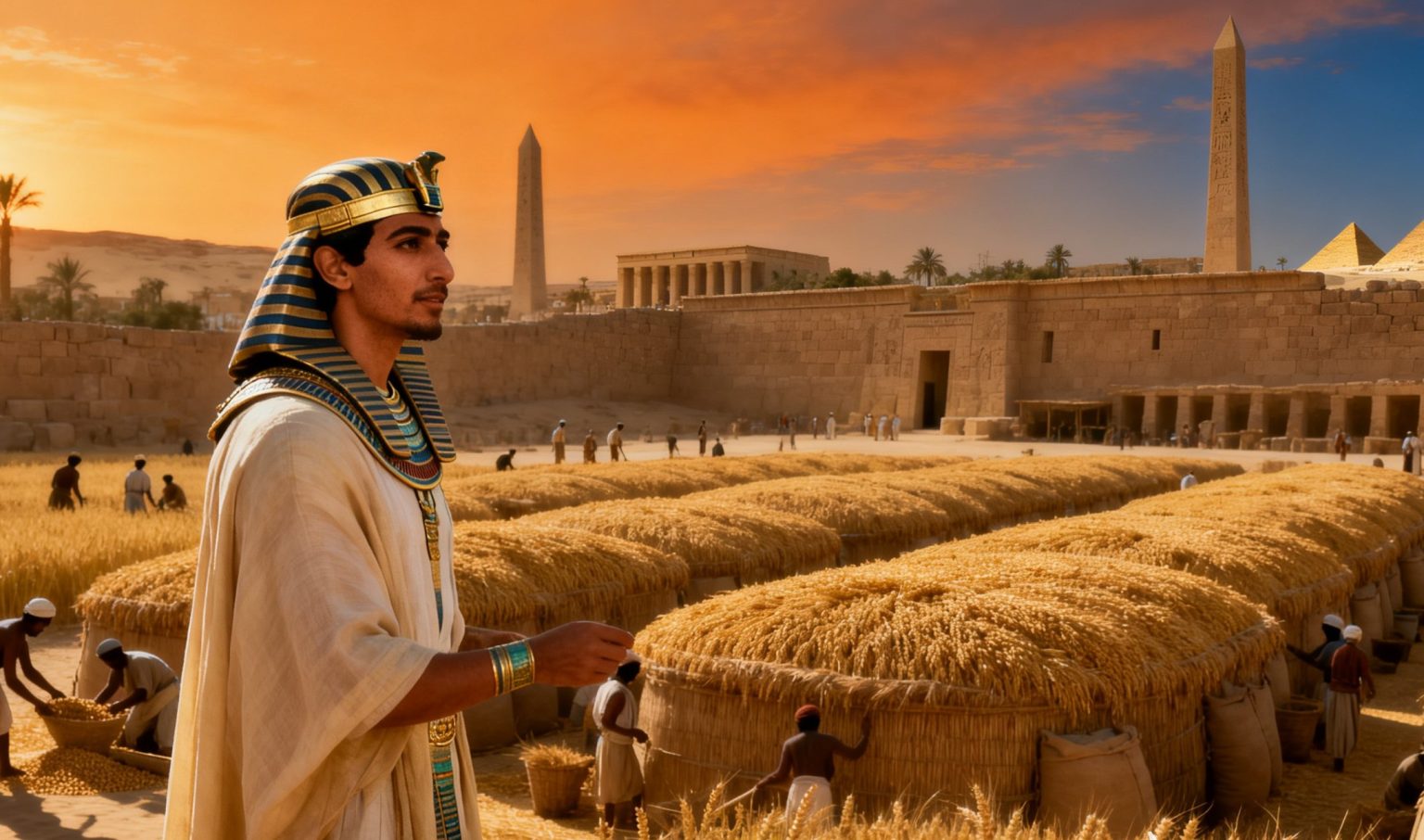
The verse above is the interpretation (ta’wil) of Prophet Yusuf (peace be upon him) of the king of Egypt’s dream at that time, in which he saw seven fat cows being devoured by seven thin cows, and seven green (fresh) ears of wheat followed by seven dry ones (QS. Yusuf [12]: 46).
The Messenger of Allah ﷺ called Prophet Yusuf (peace be upon him) “al-karim ibnul karim ibnil karim ibnil karim” (a noble man, son of a noble man, from the lineage of noble men), namely Prophet Yusuf, son of Prophet Ya’qub, son of Prophet Ishaq, son of Prophet Ibrahim (peace be upon them all).
Prophet Yusuf (peace be upon him) was born in the Al-Quds region (Palestine) around 1800–1700 BCE. From a young age, he faced severe trials, being thrown into a well by his brothers, then found by a traveler and sold into Egypt as a slave. However, this journey led him to glory, eventually being appointed as the treasurer of the Egyptian kingdom.
Read Also: Gaza’s Suffering That Moves the World’s Conscience
Imam Ibn Kathir (may Allah have mercy on him), explaining the above verse, took the opinion of the companion Ibn Abbas (may Allah be pleased with him) about the importance of consumption discipline, avoiding excess (wastefulness) even in times of abundance, and storing harvests to face difficult times (famine).
Meanwhile, other exegetes understand the above verse as a form of integration between revelation and reason. A leader is required not only to have spiritual intelligence but also strategic intelligence to solve various problems in society and the nation.
The above verse presents universal principles in managing crises. Prophet Yusuf (peace be upon him) not only interpreted the dream but also provided rational solutions, directing economic policy and social management.
Prof. Quraish Shihab, in his Tafsir Al-Misbah, explains that this verse contains principles of long-term strategic planning, resource management, and state-led governance to ensure the continuity of people’s livelihoods.
Read Also: Amid the World Cup Craze, Let’s Not Forget Palestine
The verse teaches that a crisis is not a “monster” to be feared but something to be managed. Here, the Qur’an provides guidance that the future safety of a society (nation) is determined by how they behave and act.
When connected to today’s conditions, the message of this verse feels highly relevant. The extreme climate crisis, marked by prolonged drought, aridity, and the threat of crop failure, is essentially the “seven difficult years” in a modern form. The difference is that the warning now comes through scientific data, not a king’s dream.
The 2026 El Niño Phenomenon and the Shadow of a Global Food Crisis
The international agency monitoring the global climate, the National Oceanic and Atmospheric Administration (NOAA), has released data showing a 61–62% probability of El Niño occurring around mid-2026, which has the potential to trigger major disruptions to the world’s agricultural systems.
Read Also: The Profound Meaning of the Prophet’s Hijrah, A Journey of Faith and Civilization
El Niño is known as one of the main drivers of global climate variability, causing drought in Southeast Asia, India, and Australia, as well as floods in other regions. This impact is not only ecological but also economic, affecting global food production and price stability.
Meanwhile, in Indonesia, this condition has been felt since the beginning of the year. Official data from the Agency for Meteorology, Climatology, and Geophysics (BMKG) shows that until the end of March 2026, about 7 percent of the seasonal zones had entered the dry season.
BMKG also stated that this year’s dry season is not only arriving earlier but is also more extreme compared to the normal average.
Real impacts are beginning to be seen on the ground. A report from the Indonesian Forum for the Environment (WALHI) states that several regions, such as Nusa Tenggara, Kalimantan, and parts of Sulawesi, have experienced moderate to extreme drought.
Read Also: Why Do People Cry Easily When Reading the Quran?
This condition not only threatens the availability of clean water due to drought but also increases the risk of crop failure and food crisis, especially for communities whose livelihoods depend on the agricultural sector.
In this context, the biggest challenge is not just understanding the crisis but how to respond seriously, systematically, and sustainably so that its impacts can be controlled.
Prophet Yusuf’s Crisis Management
Learning from the story of Prophet Yusuf (peace be upon him), we understand that a crisis is not just a test but an opportunity to build strength. When difficult times are managed with faith, patience, and careful planning, hardship gives birth to extraordinary resilience and fortitude, both for individuals and society.
Read Also: Debunking Zionist Myths and Falsehoods
Prophet Yusuf (peace be upon him) designed a structured and visionary crisis management system. Its success was a combination of revelation, knowledge, and managerial skill.
He did not just build economic policy but also manifested social justice. Here are five strategies of Prophet Yusuf (peace be upon him) in managing crises:
First, the ability to read the potential for crisis early on. Prophet Yusuf understood the king’s dream as a rational economic cycle that could be anticipated. Here lies the foundation of crisis management: awareness that threats can be predicted, and then preparations can be made to anticipate them.
Second, disciplined and consistent long-term planning. Prophet Yusuf formulated concrete steps in his work program. He established that the fertile period must be utilized maximally to anticipate difficult times. This shows the importance of a long-term vision in public policy.
Read Also: After Ramadan: 10 Recommended Sunnah Acts in the Month of Shawwal
Third, meticulous and knowledge-based management of food reserves. Prophet Yusuf ordered that the harvest be stored with its husks, a method scientifically proven to maintain the longevity of wheat.
Fourth, controlling consumption and instilling social discipline. Society was not allowed to drown in the euphoria of abundance. They were directed to consume only what was necessary and save the rest. In the perspective of Islamic economics, this shows the importance of balance between production and consumption. Contemporary thinkers like Yusuf al-Qaradawi, in his book *Fiqh az-Zakah*, emphasize that social justice can only be achieved if distribution and consumption are managed wisely.
Fifth, building a fair and organized distribution system. When the famine arrived, the stored food reserves were not left to be controlled by a handful of people but were managed by the state for the benefit of all citizens. Prophet Yusuf ensured that no group starved due to distribution inequality. This shows that crisis management is not just about production but also about social justice.
The success of this strategy is inseparable from trustworthy and competent leadership. Scholars see this as a legitimacy that a position may be sought if one has the ability and integrity. In this context, leadership is not merely a position but a responsibility to ensure the survival of society’s livelihood.
Read Also: Women Reciting Qur’an Use Speakers, Is It OK?
The contemporary Muslim thinker Yusuf al-Qaradawi, in *Fiqh az-Zakah*, asserts that the state bears a great responsibility in guaranteeing the basic needs of society, including food. He emphasizes that distributive justice is part of the social justice that must be realized.
If drawn into a modern context, Prophet Yusuf’s approach aligns with the thinking of an Indian scientist and environmental figure, Vandana Shiva, who in her work “Soil Not Oil: Environmental Justice in an Age of Climate Crisis” emphasizes the importance of a sustainable and self-reliance-based food system.
She asserts that the global food crisis is not solely caused by nature but by humanity’s failure to manage resources wisely. Wasteful behavior, exploitative policies, and a lack of long-term orientation cause societies to lose resilience when a crisis arrives.
Thus, the current extreme climate crisis should become a turning point for change, towards a societal resilience grounded in spiritual values, supported by visionary management, and aimed at realizing a socially just society. []
Read Also: The Habit of Reading Qur’an Promotes Health, Here Is the Scientific Explanation!
وَاللَّهُ أَعْلَمُ بِالصَّوَابِ
Mi’raj News Agency (MINA)
Read Also: Health Benefits of Breaking Fast With Water and the Recommended Intake
























 Mina Indonesia
 Mina Arabic
 Mina Sport
