






By Imaam Yakhsyallah Mansur
بِسْمِ اللَّهِ الرَّحْمَنِ الرَّحِيمِ
Allah Subhanahu wa Ta’ala says:
وَإِذَا تَوَلَّىٰ سَعَىٰ فِي الْأَرْضِ لِيُفْسِدَ فِيهَا وَيُهْلِكَ الْحَرْثَ وَالنَّسْلَ ۗ وَاللَّهُ لَا يُحِبُّ الْفَسَادَ (البقرة [٢]: ٢٠٥)
Read Also: Amid the World Cup Craze, Let’s Not Forget Palestine
“And when he turns away (from you), he strives throughout the land to cause corruption therein and destroys crops and livestock. And Allah does not like corruption.” (QS. Al-Baqarah [2]: 205).
Imam Ibn Jarir Ath-Thabari Rahimahullah in his book Jami’ al-Bayan explained this verse by citing the interpretation of the companion Ibn Abbas Radhiallahu anhu, that al-harth refers to crops that grow on earth, while an-nasl encompasses the offspring of living beings, including humans.
Mujahid explained that an-nasl also includes humans and animals. Thus, the verse does not merely speak about the destruction of objects and the environment, but about the annihilation of the sources of human life and the continuity of generations.
Sayyid Qutb in Fi Zilal al-Qur’an described al-harth and an-nasl as symbols of the continuity of life. The corruption committed by oppressive people is not merely about destroying physical structures, but about destroying the very elements that sustain human life.
Read Also: The Profound Meaning of the Prophet’s Hijrah, A Journey of Faith and Civilization
The verse above contains a universal moral principle. Allah Ta’ala abhors actions that destroy life. When the elements that sustain life are destroyed, that is a tangible form of great injustice.
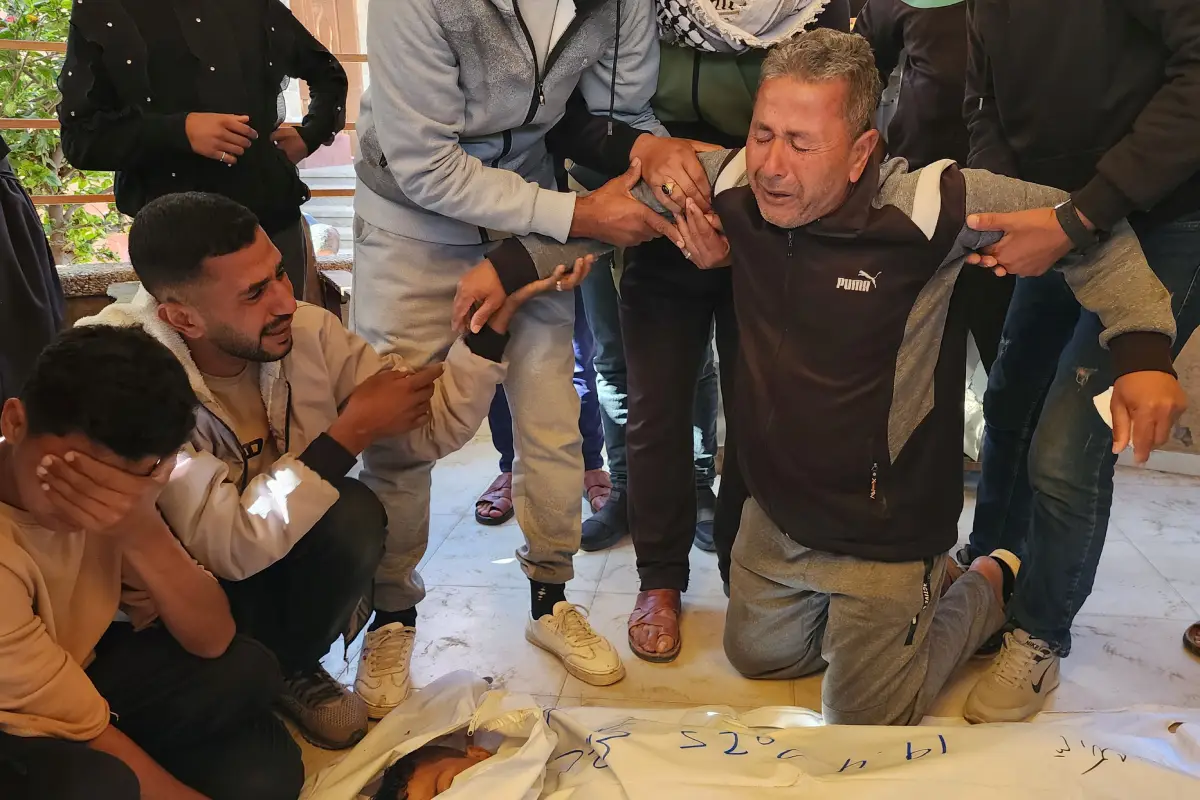
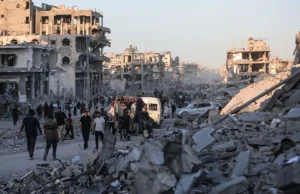
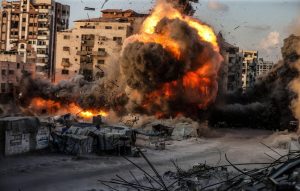
The word an-nasl is particularly worth reflecting upon in the context of the genocide in Gaza carried out by Zionist Israel. Because the people of Gaza today are suffering not only for the living today, but also for an entire generation.
The closing message of the verse is very clear: “Allah does not like corruption.” This is the principle that should serve as a mirror for the world’s conscience. The destruction of human life should not be considered normal or acceptable. The verse seems to call upon humanity to ask once more: does the world still have a conscience when the life of a nation lies under threat of annihilation?
When Surviving Becomes a Struggle
Read Also: Why Do People Cry Easily When Reading the Quran?
The situation in Gaza from October 2023 to today is far from normal. A report from the UN Office for the Coordination of Humanitarian Affairs (OCHA) on August 28, 2026, stated that humanitarian conditions in the territory remain critical. Nearly all of Gaza’s population faces extremely poor living conditions, with limited access to basic services, including food and healthcare.
A report from the Integrated Food Security Phase Classification (IPC) released in July 2026 showed that more than 1.2 million people in Gaza are experiencing acute food crisis conditions or worse. That number is projected to rise to more than 1.4 million people if massive humanitarian intervention is not urgently carried out.
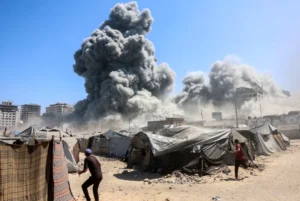
Amid this situation, humanitarian aid remains the main lifeline for Gaza’s residents. As of August 20, 2026, 95 kitchens continue to produce food distributed daily across various areas of Gaza. However, the scale of need means such aid has not restored normal life.
Humanitarian aid currently serves only as a temporary effort to prevent greater suffering, while limited access and supply chain disruptions caused by the Zionist blockade remain major obstacles.
Read Also: Debunking Zionist Myths and Falsehoods
The health crisis is also severely felt. In July 2026, OCHA reported only about 44 health service points still functioning. Under these conditions, Gaza’s health system must serve tens of thousands of people daily under severe constraints.
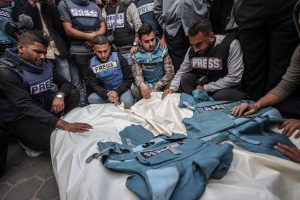
WHO also recorded 98 attacks on health services between January and July 2026. These attacks affected 83 health service vehicles and 11 health facilities, resulting in 33 injuries and four medical personnel martyred.
Gaza also faces sanitation issues and disease outbreaks. Crowded displacement, damaged water and sewage infrastructure, and limited health facilities create an environment highly vulnerable to disease transmission.
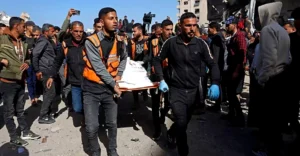
Behind the above statistics, there is a mother searching for food for her children. A father striving to find shelter for his family after his home was destroyed. A child learning without a classroom. A doctor working with limited medicine. A family trying to rebuild life amid the ruins.
Read Also: Learn from Prophet Yusuf about Food Security Management During the Extreme Climate Crisis
But Gaza does not only present stories of destruction. Its residents also demonstrate steadfastness. Amid the rubble, children continue to learn, mothers send blessings upon the Prophet while queuing for water and caring for their families. Fathers remain persistent in seeking help to support their families. Nearly all of Gaza’s residents continue to perform their worship amid the ruins of mosques.
This steadfastness does not mean they do not feel pain. Precisely because they feel such immense loss, their ability to endure becomes a driving spirit to continue on with life.
Perhaps the tired faces of Gaza’s residents often escape the spotlight of mainstream media cameras. But they continue trying to tell the world that they are not merely victims, but human beings who still hold hope and a future.
From the Nakba of 1948 to Gaza 2026: Crimes Continue
Read Also: After Ramadan: 10 Recommended Sunnah Acts in the Month of Shawwal
The year 1948 marks a deeply painful historical point for the Palestinian people. The Nakba tragedy was a mass expulsion event that caused more than half of Palestine’s population to be driven from their homes. That event continues to haunt Palestinians to this day.
Since then, killings, land confiscation, destruction of settlements, displacement, and a series of humanitarian tragedies have continued to be part of the Palestinian struggle.
In the following years, major wars occurred. In 1967, 1987, 2002, 2006, 2008, and beyond, various areas of Palestine experienced crises, occupation, restrictions, attacks, and various acts of violence. This series of events shows that the Palestinian issue is a long-standing issue that has continued for decades.
Strangely, the brutality of Zionist Israel over these many years has received political, military, and diplomatic support from a number of countries that claim to uphold democracy, human rights, and humanitarian law. This support has given Israel broad political space, even though various international bodies have repeatedly highlighted alleged violations of Palestinian rights.
Read Also: Women Reciting Qur’an Use Speakers, Is It OK?
A shift in global attitudes, with growing sympathy for Palestine, has emerged more strongly following the Gaza tragedy since 2023. A number of countries, particularly in Europe and Latin America, have begun taking more critical stances toward Israeli policy, while civil society support for Palestine has grown increasingly widespread.
However, this shift does not mean Western support for Israel has ended. The United States remains a key ally of Israel. Meanwhile, Gaza’s suffering has led more Americans to question their government’s policy toward Israel, fueling political debate over that support.
When Conscience Becomes the Measure
The Palestinian crisis is a test of human conscience. When people treat the Gaza tragedy as something normal, we are in fact facing a moral issue far greater than mere political differences.
Read Also: The Habit of Reading Qur’an Promotes Health, Here Is the Scientific Explanation!
In Islam, concern for the suffering of others is part of religious teaching. The Prophet Shallallahu ‘alaihi wa Sallam said, meaning:
“The example of the believers in their mutual love, mercy, and compassion is like that of one body; when one part of the body suffers, the whole body responds with fever and sleeplessness.” (Narrated by Muslim).
In another hadith, the Prophet Shallallahu ‘alaihi wa Sallam said that whoever relieves a Muslim’s distress, Allah will relieve their distress on the Day of Judgment.
These hadiths convey that concern for others’ suffering must be manifested in concrete action, not stopping at pity and sympathy alone.
Read Also: Health Benefits of Breaking Fast With Water and the Recommended Intake
The humanitarian message of the late Nelson Mandela is also relevant to reflect upon. In his history of struggle against apartheid, Mandela viewed Palestinian freedom as inseparable from the fight against oppression.
In his speech on International Day of Solidarity with the Palestinian People in 1997, Mandela expressed solidarity with the Palestinian people and called for the flame of solidarity, justice, and freedom to remain alight.
The Nelson Mandela Foundation also noted the strong connection between South Africa’s anti-apartheid struggle and the Palestinian struggle, particularly in the context of decolonization and the fight for self-determination, although the historical contexts are certainly not entirely identical.
Defending Palestine means defending the human right to life, freedom, and liberation from all forms of oppression. That concern can be expressed through prayer, humanitarian aid, speaking the truth, supporting diplomacy and international law, and not letting humanitarian tragedy pass unnoticed.
Read Also: The Purpose of Fasting in Ramadan is Taqwa
UN Special Rapporteur on the situation of human rights in the occupied Palestinian territories, Francesca Albanese, called the Gaza tragedy “the shame of our time,” because such suffering occurs when the world already has legal instruments, international institutions, and various mechanisms to prevent humanitarian crimes.
For those who choose to close their eyes, Gaza may be just news flashing across television screens. But for hearts that are still alive, every tragedy is a call of conscience to humanity.
Gaza teaches one important lesson: the destruction of buildings does not necessarily mean the destruction of a nation. Homes can be leveled, schools destroyed, hospitals damaged, land occupied, and people forced to flee, but as long as the people maintain their faith and hope, life will find a way to grow again.
That is the meaning of an-nasl worth reflecting upon: life that strives to continue, even when facing a great force that seeks to sever its chain.
To the world, Gaza seems to say: “We are still here and still nurturing hope to continue life and civilization.”
History does not only record who destroyed life. History will also record who cared about humanitarian tragedy, who chose silence, and who, with empathy, took real action to help the oppressed.
In the end, Gaza is not only a test for the Palestinian and Arab nations. Gaza is a test for all humanity: whether we can still feel others’ suffering, defend justice, and protect life as the world witnesses destruction before our eyes.[]
وَاللَّهُ أَعْلَمُ بِالصَّوَاب
Mi’raj News Agency (MINA)













 Mina Indonesia
 Mina Arabic
 Mina Sport