





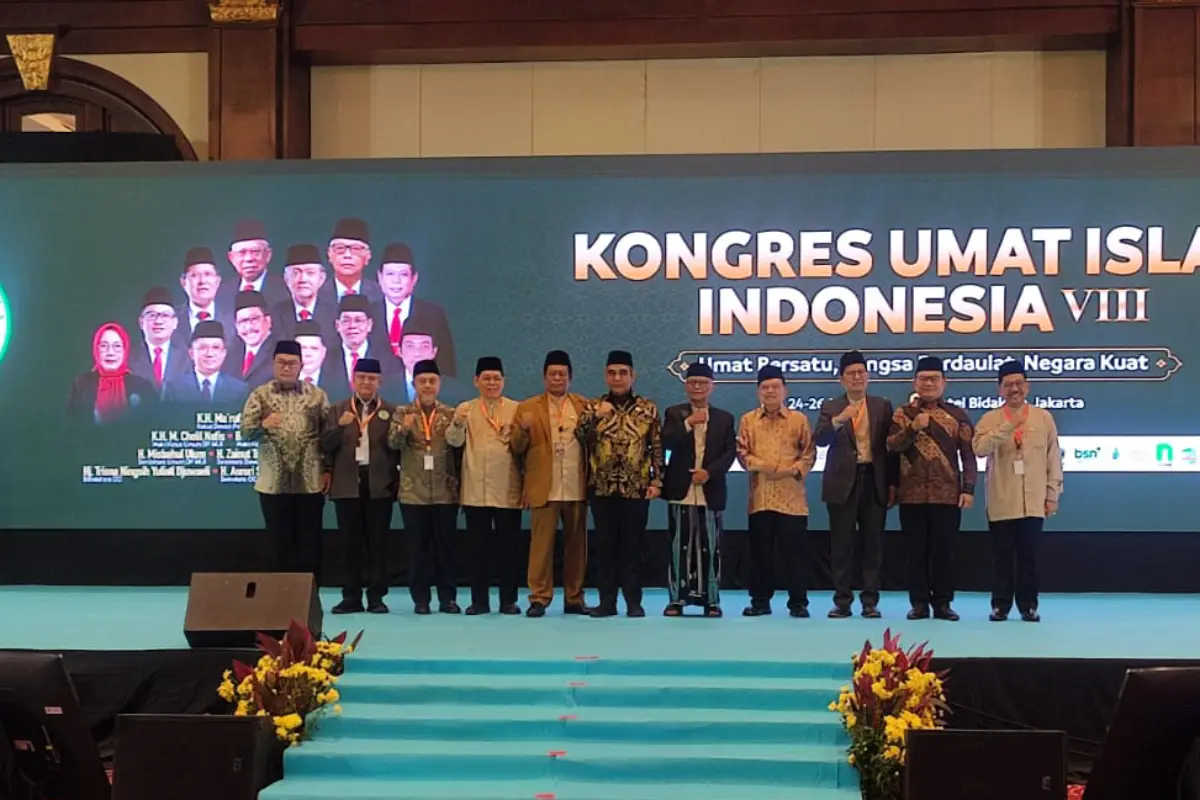
Jakarta, MINA – The 8th Indonesian Muslim Congress (KUII VIII) has issued a “Tausiyah Amanah Kepemimpinan Umat, Bangsa, dan Negara” (Message of Trust for the Leadership of the Ummah, Nation, and State) containing 11 strategic agendas as recommendations for the government, state institutions, mass organizations, and all elements of the nation.
The recommendations were read by the Head of the Fatwa and Methodology Division of the Central Indonesian Ulema Council (MUI), Buya Gusrizal Gazahar Datuak Palimo Basa, at the closing of KUII VIII at the Bidakara Hotel in Jakarta on Sunday evening.
The congress participants discussed and deliberated in depth, critically, constructively, and provided solutions, seeking God’s blessings in formulating the recommendations.
The 11 recommendations are as follows:
Read Also: Indonesia Bans Israel Houghton Concert Over Palestine Stance
1. Economic Reactualization: The congress recommended the reactualization of Pancasila economics and sharia economics as the mainstream of national development. Concrete steps include establishing a sharia treasury fund, strengthening cooperatives, MSMEs, and pesantren, agrarian reform, protecting state assets, technological sovereignty, and bureaucracy reform oriented towards public welfare.
2. Sharia Economic Body: The congress proposed the establishment of a sharia economic body as a state institution to serve as the center for developing the sharia system, ecosystem, business, and investment. This institution is expected to strengthen the ummah’s competitiveness in facing the demographic bonus and welcoming Indonesia Emas 2045.
3. Empowerment of People’s Economy: KUII VIII urged the government to strengthen people’s economic empowerment through cooperatives, MSMEs, and sharia economics. It also called for ensuring that national investment policies favor sharia principles and limit oligarchic practices that hinder equitable welfare distribution.
4. Education System Reorientation: The congress called for a reorientation of the national education system by making faith, piety, and morality the spirit of education. It also encouraged strengthening the position of pesantren, madrasahs, and religious colleges within the national education system and ensuring equitable distribution of education budget support.
Read Also: Indonesia’s Anak Krakatau Erupts Twice, Volcanic Ash Moves Northwest
5. Science and Technology Sovereignty: The congress emphasized the importance of mastering science and technology as a condition for national sovereignty. The government was urged to strengthen national research, integrate science with Islamic education, and develop technological independence in strategic sectors.
6. LGBTQ Issue: The congress expressed concern over the spread of LGBTQ deviant sexual behavior. KUII VIII supports prevention efforts through a comprehensive approach based on religious values, Pancasila, and laws. It urged the President and the House of Representatives (DPR) to immediately discuss the Bill on Prevention and Mitigation of Deviant Sexual Behavior or LGBTQ.
7. AI and Digital Sovereignty: The congress called for strengthening artificial intelligence (AI) and digital sovereignty based on religious values, Pancasila, and ethics to protect the public from disinformation, digital manipulation, data exploitation, and moral degradation.
8. Family Resilience: KUII VIII emphasized the importance of strengthening family resilience through policies that support the family institution, character education, protection of women and children, and mentoring for individuals facing social and moral issues with a dakwah bil hikmah approach.
Read Also: PBNU Makes 2026 Santri Day a Momentum for Palestine Solidarity
9. Unity of the Ummah: The congress called for strengthening the unity of the Muslim community through deliberation, ukhuwah, tolerance, joint studies, and inter-institutional communication. MUI and Islamic mass organizations are expected to strengthen consolidation of the ummah in facing various national challenges.
10. Morality as Social Capital: KUII VIII affirmed that morality is a social capital for the establishment of just law. The congress encouraged strengthening ethics in bureaucracy, professions, mass organizations, and the business world through the institutionalization of an ethics justice system.
11. Global Diplomacy: The congress established the strengthening of global diplomacy as a strategic agenda by reaffirming Indonesia’s support for Palestinian independence, strengthening Indonesia’s leadership in the Organization of Islamic Cooperation (OIC) and the Global South, and increasing Indonesia’s representation in various international institutions under the OIC’s auspices.
Closing the reading of the tausiyah, KUII VIII affirmed that all these recommendations are a form of the Muslim community’s moral responsibility in providing solutions to various issues facing the nation and state, as well as an effort to realize a more just, advanced, and dignified Indonesia.[]
Read Also: Magnitude 5.9 Earthquake Strikes Aceh Jaya; Tremors Felt in Several Areas
Mi’raj News Agency (MINA)


















![Security forces take measures as protesters gather outside Woolwich Crown Court to show support for a group known as the “Filton 24,” whose trial is ongoing over a protest at an Israeli defense company’s facility in Bristol in 2024 in London, United Kingdom on June 12, 2026. [Aysu Biçer – Anadolu Agency]](https://en.minanews.net/wp-content/uploads/2026/06/Screenshot_2026-06-13-17-48-18-76_40deb401b9ffe8e1df2f1cc5ba480b12-300x194.jpg)


 Mina Indonesia
 Mina Arabic
 Mina Sport