




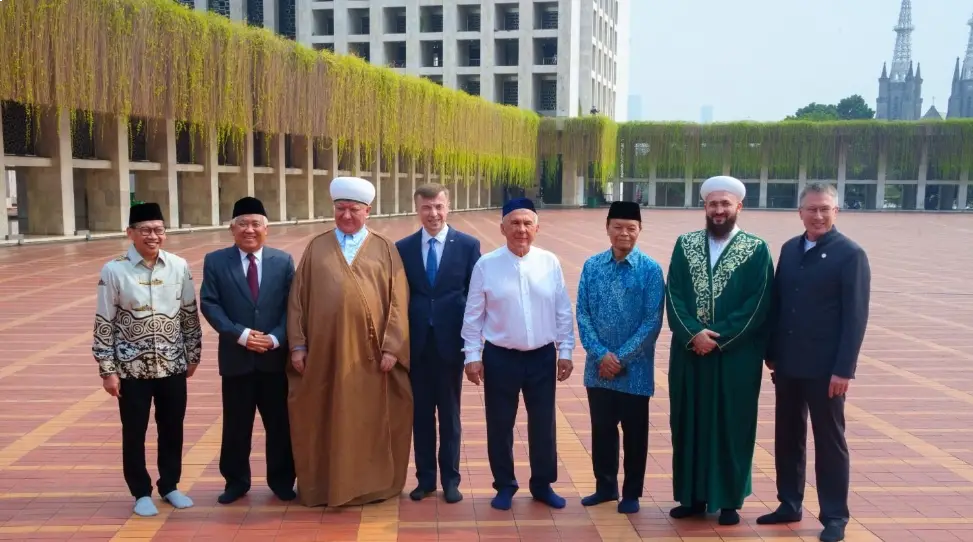
Jakarta, MINA – The Russian Embassy in Indonesia inaugurated Russian Space, a cultural and educational room at the Istiqlal Mosque library in Jakarta, on Friday, November 6, describing the facility as part of efforts to strengthen Indonesia-Russia relations through cultural and religious diplomacy.
The room is designed to allow Indonesians to learn about Russian culture, traditions, and the development of Islam in Russia. The facility is also open to visitors of Istiqlal Mosque, the largest mosque in Southeast Asia.
Russian Ambassador to Indonesia Sergei Tolchenov expressed confidence that the room would strengthen interfaith relations between the two countries. He also expressed hope that the space would promote Russian culture and traditions to the Indonesian public.
Tolchenov said cooperation between the two countries continues to develop in multilateral forums, student exchanges, and expert exchanges. According to him, the religious field is one of the key sectors in the strategic partnership signed by President Vladimir Putin and President Prabowo Subianto in 2025.
Read Also: KSrelief Launches First Phase of Earthquake Relief Aid on Flores Island
He also mentioned cooperation through the Russia-Islamic World Strategic Vision Group. Russia, he said, welcomes Indonesia’s interest in engaging, including the participation of Indonesian figures in the group’s annual meetings.
Farid Saenong, special staff to the Minister of Religious Affairs, representing Minister Nasaruddin Umar, said the room’s presence was in line with the vision of Istiqlal as a center of world civilization.
According to Farid, Istiqlal opens itself to any party wishing to present cultural facilities, as part of religious and cultural diplomacy.
The Istiqlal library previously had cultural rooms from the United States, China, and the Netherlands. A similar room from Australia already exists, and Turkiye is expected to follow.
Read Also: Indonesian Army Helicopter Crashes in Seruyan During Firefighting Mission
The opening of Russian Space places Russia alongside the US, China, the Netherlands, and Australia as countries with a dedicated cultural presence inside Southeast Asia’s largest mosque, a striking concentration of diplomatic soft power in a single religious institution.
The choice of venue carries particular significance. Istiqlal is not only a place of worship but a symbol of Indonesian religious pluralism, famously designed by a Christian architect, Frederich Silaban, and located opposite Jakarta’s Catholic Cathedral. Hosting foreign cultural rooms there positions the mosque as a platform for interfaith and international engagement rather than a purely devotional space.
For Russia, the room serves several purposes. It provides a channel to present Russian Islam, which has a long history in Tatarstan and the North Caucasus, to an Indonesian audience that may be unfamiliar with Muslim communities outside the Middle East and Southeast Asia. It also builds on the strategic partnership signed by Putin and Prabowo in 2025, extending cooperation beyond defense and energy into the religious and cultural sphere.
Tolchenov’s reference to the Russia-Islamic World Strategic Vision Group is notable because that body is designed to position Russia as a partner to Muslim-majority countries, a diplomatic posture Moscow has cultivated for years. Indonesia’s participation would add the world’s largest Muslim-majority nation to that framework.
Read Also: Indonesia: Over 91,000 Children Under Five Hit by Respiratory Infections
The presence of multiple foreign cultural rooms at Istiqlal also reflects a broader trend in Indonesian religious diplomacy, in which the mosque’s leadership has sought to position it as a global center for dialogue. The planned addition of a Turkish room suggests that this model will continue to expand, with each room representing a bilateral relationship embedded within a shared religious space.[]
Mi’raj News Agency (MINA)
Read Also: Indonesia Wildfires: 864 Hotspots Detected Across Six Provinces














 Mina Indonesia
 Mina Arabic
 Mina Sport
