






The early 1990s marked one of the darkest chapters in the history of Azerbaijan. During the First Karabakh War, large parts of Azerbaijan’s Karabakh region and seven adjacent districts came under the control of Armenian armed forces. The hostilities were accompanied by widespread displacement, violence against civilians, and the forced expulsion of hundreds of thousands of Azerbaijanis from their homes. For Azerbaijan, these events are inseparable from a broader narrative of occupation, ethnic cleansing, and long-term humanitarian suffering.
Of all the tragedies that occurred during that period, the events in Khojaly on the night of 25–26 February 1992 remain one of the most painful and defining moments in the history of Azerbaijan.
At the time, Khojaly was a town of around 7,000 residents, strategically located near the region’s only airport and along key roads linking Shusha, Khankendi, and Aghdam. By late 1991, it had been effectively besieged: land routes were blocked, and basic utilities such as electricity, gas, and water had been cut off, leaving civilians in an increasingly desperate situation.
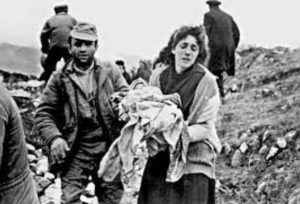
In the early hours of 26 February 1992, following heavy shelling, Armenian armed units, reportedly supported by the 366th Motorized Rifle Regiment of the former Soviet Army entered the town. As civilians attempted to flee through snow-covered terrain, many were killed. Azerbaijani official sources state that 613 civilians lost their lives, including 106 women, 63 children, and 70 elderly people. Hundreds more were injured, and over a thousand were reportedly taken hostage, with some still listed as missing.
Also Read: The Impact of Strikes Against Iran on Palestinian Resistance Movement
International organizations and observers documented serious violations of international humanitarian law during the conflict. Human Rights Watch characterized the events in Khojaly as the largest massacre of the Karabakh conflict and attributed responsibility to Armenian forces. For Azerbaijan, Khojaly is not viewed as an isolated atrocity but as part of a systematic campaign aimed at removing Azerbaijanis from their internationally recognized territories.
Over the decades, Azerbaijan has campaigned for international recognition of the Khojaly tragedy. Several countries and numerous U.S. states have adopted resolutions condemning the massacre, with some referring to it as genocide. The “Justice for Khojaly” initiative, launched by the Heydar Aliyev Foundation, has organized exhibitions, conferences, and memorial events around the world to raise awareness and commemorate the victims. For many Azerbaijanis, remembrance is closely tied to the pursuit of legal and moral accountability.
The 2020 war and subsequent developments in 2023 significantly altered the situation on the ground. Azerbaijan liberated its territories that had been occupied for nearly three decades, asserting that it had restored its sovereignty and territorial integrity. In the aftermath, investigations in the formerly occupied areas led to the discovery of multiple mass graves containing the remains of civilians and other protected persons. These findings confirm the widespread violations committed during the years of occupation.
From a legal perspective, Azerbaijan maintains that serious breaches of international humanitarian law, such as the deliberate targeting of civilians, the mistreatment of prisoners, hostage-taking, and the destruction of cultural and religious heritage—must not go unpunished. It cites international conventions and repeated affirmations by the United Nations General Assembly and Security Council regarding states’ obligations to investigate and prosecute grave crimes. Recently, proceedings have been initiated against individuals accused of participating in violent acts during the conflict, marking important steps toward long-delayed justice. However, many perpetrators still remain escape beyond the reach of domestic courts, having found refuge abroad. They contend that denial of responsibility and political efforts to block accountability undermine the prospects for lasting peace in the region.
Also Read: Who Will Succeed Khamenei? Understanding Iran’s Leadership Succession Pattern
For Azerbaijan, the legacy of Khojaly and the broader conflict is not confined to history books. It shapes contemporary policy, national identity, and the country’s approach to reconciliation and regional stability. While the restoration of territorial control has changed the geopolitical landscape, the emotional and human dimensions of the conflict remain deeply felt. As Azerbaijan continues reconstruction in the formerly affected areas, it also reiterates its call for acknowledgment, accountability, and a durable peace grounded in justice and respect for international law.
Khojaly: History That Demands Justice
The early 1990s remain one of the most painful periods in Azerbaijan’s modern history. During the First Nagorno-Karabakh War, 20 percent of Azerbaijan’s internationally recognized territory was occupied by Armenian forces, resulting in ethnic cleansing and the displacement of approximately one million Azerbaijanis as refugees and internally displaced persons.
Among the many tragedies of that war, the events that unfolded in Khojaly on the night of February 25–26, 1992, stand out as particularly devastating.
Also Read: Ramadan 2026: Global Fasting Durations From Longest to Shortest
At the time, Khojaly was home to around 7,000 residents. Its location near the region’s only airport and key roads made it strategically important. By late 1991, the town had been effectively cut off: supply routes were blocked, and essential services such as electricity, gas, and water had been severed. Civilians were living under increasingly dire conditions.
In the early hours of February 26, after heavy shelling, Armenian armed units reportedly supported by the 366th Motorized Rifle Regiment of the former Soviet Army entered the town. Following intense artillery shelling, the town was overrun, with civilians deliberately targeted in a ruthless assault. Survivors of the tragedy recount scenes of profound horror-people shot while attempting to escape through snow-covered forests, and bodies subjected to mutilation and abuse.
As a result of the attack and capture of the city, 613 people were killed, including 106 women, 63 children, and 70 elderly persons. A total of 1,275 residents were taken hostage, and the fate of 150 of them remains unknown. Additionally, 487 people were injured, including 76 children. Eight families were completely wiped out; 25 children lost both parents, and 130 lost one parent. Reports indicate that 56 victims were killed with particular cruelty.
International observers documented serious violations of international humanitarian law during the conflict. Human Rights Watch described the events in Khojaly as the largest massacre of the Karabakh war.
Also Read: The History of Ramadan Fasting: Before and Until Muhammad ﷺ
In the decades since, Azerbaijan has sought international recognition of the Khojaly events. As part of the “Justice for Khojaly!” campaign, the Khojaly massacre has been recognized as an act of genocide by 23 U.S. states and a number of national parliaments across Europe, Asia, Africa, and Latin America, as well as by the Organization of Islamic Cooperation and the Organization of Turkic States.
The outcomes of the Second Nagorno-Karabakh War and the 2023 anti-terrorist operation restored Azerbaijan’s control over its internationally recognized territories after more than 30 years of occupation.
In the liberated territories, investigators have reported the discovery of mass graves containing the remains of civilians. Atrocious violations committed during the conflict including attacks on civilians, hostage-taking and the destruction of cultural heritage must be investigated and prosecuted in accordance with international law. Although legal proceedings have been initiated in recent years, many of those responsible have yet to be held accountable and continue to evade justice.
As in other liberated areas, life is gradually returning to Khojaly. Although it remains one of the deepest wounds in nation’s memory, the state and people of Azerbaijan continue to honor the victims and preserve their remembrance.[]
Also Read: Don’t Buy the Wrong Dates: 6 Ways to Identify Israeli Dates
Source: Embassy of Azerbaijan in Jakarta
Mi’raj News Agency (MINA)
Also Read: A Critical Question: “I Want to Ask You, Americans







 Mina Indonesia
 Mina Arabic
 Mina Sport