





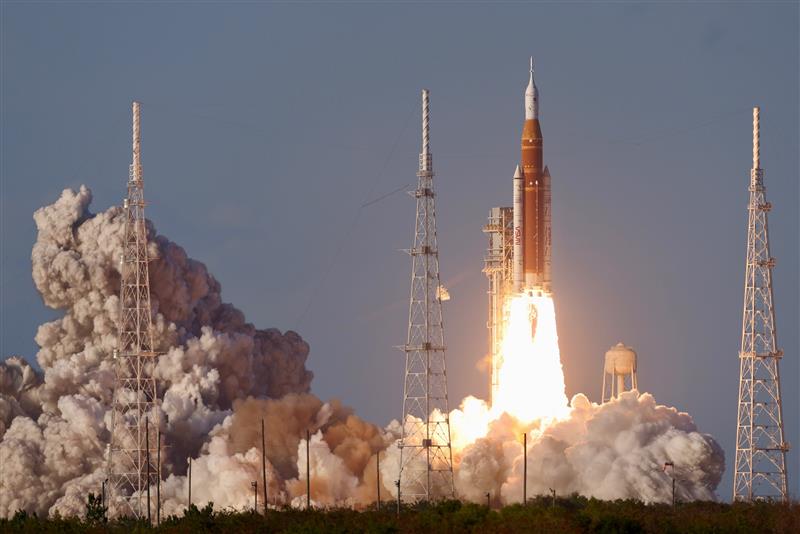

Florida, MINA – Nasa’s first manned Moon mission in more than 50 years, which will take astronauts deeper into space than any human has gone before, blasted off on Wednesday evening from Cape Canaveral in Florida.
Quoted from The National, the 98-metre Artemis II rocket, taller than the Statue of Liberty, reached speeds of more than 28,000kph as it hurtled into space, blazing a trail of fire and smoke as it climbed, and eventually shedding its spent side boosters that provided extra thrust.
The Artemis II crew of Nasa astronauts Reid Wiseman, Victor Glover and Christina Koch, and Canadian Space Agency astronaut Jeremy Hansen are poised for a nearly 10-day expedition around the Moon and back, taking them deeper into space than humans have ever gone.
After nearly three years of training, the crew is the first to fly in Nasa’s Artemis programme, a multibillion-dollar series of missions designed in 2017 to build up a long-term US presence on the Moon over the next decade and beyond.
Also Read: US, Indonesia Announce Major Defense Cooperation Partnership
The so-called lunar fly-by will send the crew about 405,500km into space before returning to Earth. The record for the furthest space flight is about 400,000km, held by members of the Apollo 13 lunar mission in 1970, which was hit by technical problems.
As it passes beyond the far side of the Moon, the Orion module will lose communication with the Earth for up to 50 minutes.
While the astronauts will not touch down on the Moon, the Artemis II mission paves the way for a future lunar landing and also lays the foundation to send a crew to Mars.
Historic moment
Also Read: Sanders to Force Senate Vote Blocking Major US Arms Sale to Israel
The last time Nasa sent astronauts to the Moon was as part of the Apollo 17 mission in 1972. Nasa is seeking to return a crew to the lunar surface by 2028, before China aims to achieve the feat in about 2030.
UAE astronaut Dr Sultan Al Neyadi, who became the first Arab to perform a spacewalk when he spent six months on board the International Space Station in 2023, described the launch as a “historic moment”.
“I wish success to our Artemis II colleagues as they carry out a fly-by mission that marks a key step towards returning astronauts to the Moon for the first time since Apollo 17 in 1972,” he wrote on X.
“This 10-day mission lays the groundwork for years of lunar exploration to come,” added Dr Al Neyadi, who is Minister of State for Youth Affairs.
Also Read: Trump Post Depicting Himself as Jesus Deleted from Social Media
The Mohammed bin Rashid Space Centre also wished the mission every success in a post on X. []
Mi’raj News Agency (MINA)
Also Read: Bernie Sanders to Introduce Resolution Stopping US Military Aid to Israel






















 Mina Indonesia
 Mina Arabic
 Mina Sport