





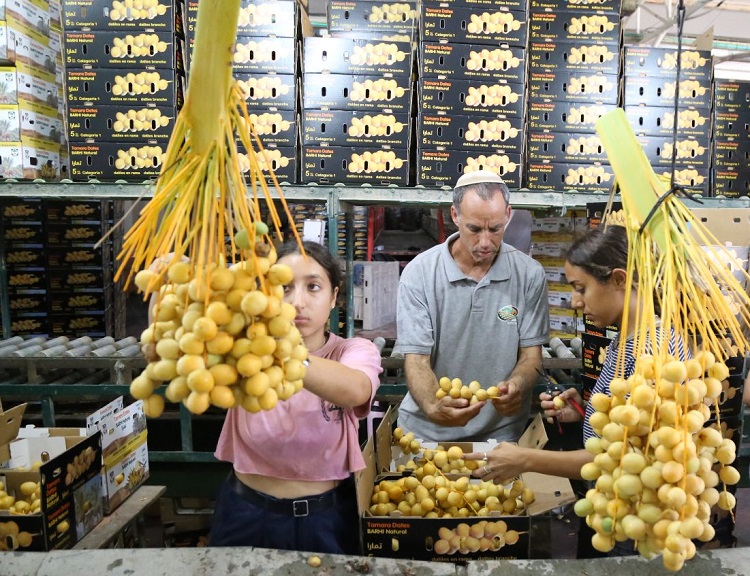

Since October 7, 2023, Israel’s military assault on Gaza has resulted in tens of thousands of deaths and hundreds of thousands of injuries. Ongoing attacks have devastated healthcare systems, schools, and civilian infrastructure, effectively paralyzing daily life in Gaza. This violence does not occur in isolation; it is supported by institutions and corporations that finance illegal settlements and the Israeli military industry.
As Ramadan approaches, Israel significantly increases its global export of dates, a food deeply associated with breaking the fast for Muslims worldwide. Many of these dates are cultivated on confiscated Palestinian land in illegal settlements. Profits from this trade contribute to the expansion of settlements and help sustain the broader system of occupation.
According to the Islamic Human Rights Commission, approximately 75% of Medjool dates circulating in the global market are produced in Israel, and around 60% of those originate from illegal settlements. This raises an ethical dilemma for Muslim consumers: how can we ensure that what we consume is not only halal in substance, but also free from complicity in injustice and oppression?
As an act of moral responsibility and solidarity with the Palestinian people, many advocates encourage continued boycotts of Israeli date products.
Read Also: Where Is Oday?
How to Identify Dates from Israel
To avoid purchasing Israeli dates unintentionally, consider the following steps:
1. Check the Country of Origin
Always read the packaging carefully. Look for the “Country of Origin” label. Products marked “Israel” should be avoided if you are participating in a boycott.
Read Also: A Severed Foot Inside a Cardboard Box
2. Examine the Barcode
Israeli products typically have barcodes beginning with the number 729, which is Israel’s country prefix.
3. Recognize Brands Linked to Israel
Some exported Israeli date brands include Jordan River, King Solomon, King Medjool, and Bahri.
Read Also: Raed Marouf, Young Triple Amputee
4. Watch for “Exported by Hadiklaim”
Hadiklaim is one of Israel’s largest date exporters and a major supplier of Medjool dates globally.
5. Be Cautious of Misleading Packaging
Some products use Arabic text or Palestinian imagery on packaging, which can mislead consumers about the product’s origin. Always verify the country of origin rather than relying on design elements.
Read Also: Meaning Behind Palestinian Ambassador’s Kiss on Imaam Yakhsyallah’s Forehead
6. Avoid Products with Unclear Origin
Be wary of products that do not clearly state the producer or country of origin. Israeli exporters known in the global market include Mehadrin, MTex, Galilee Export, Edom, Carmel Agrexco, and Arava.
7. Consider Pricing
Israeli dates are sometimes sold at lower prices due to state subsidies, which can make them more competitive in international markets.
Read Also: Remembering the 1969 Al-Aqsa Mosque Arson: A Tragedy That United the Muslim World
Brands Reportedly Linked to Israeli Date Exports
Consumers seeking to avoid Israeli products often monitor brands such as:
Bomaja, Bonbierra, Brousse & Fils, Carmel Agrexco, Delilah, Desert Diamond, Hadiklaim, Jordan River, Jordan Valley, Jordan Plains, Anna and Sarah, Urban Platter, King Solomon, MyJool, Mehadrin, Nava Fresh, Premium Medjoul, Rapunzel, Red Sea, Royal Treasure, Fancy Medjoul, Kalahari, Tamara Barhi, Paradise Dates, Shams, Star Dates, Food to Live, and Sincerely Nuts.
(Consumers are encouraged to verify current sourcing information, as supply chains may change.)
Read Also: Abu Ayyub Al Anshari, the Inspirer of Constantinople’s Liberation
A Matter of Conscience
Understanding where our food comes from is part of ethical consumption. For many, choosing not to purchase Israeli dates is a form of peaceful protest against occupation and settlement expansion.
As Ramadan reminds Muslims of justice, compassion, and solidarity, consumer choices become expressions of moral alignment. Checking product origins, educating family and community members, and supporting alternative suppliers are practical steps individuals can take.
Choosing dates from ethical and transparent sources is seen by many advocates not only as solidarity with Palestinians, but also as a way to ensure that what we consume aligns with our values.[]
Read Also: Sa’ad bin Abi Waqqash, the First Islamic Archer and Inhabitant of Heaven
Mi’raj News Agency (MINA)















 Mina Indonesia
 Mina Arabic
 Mina Sport
