







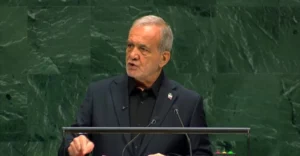
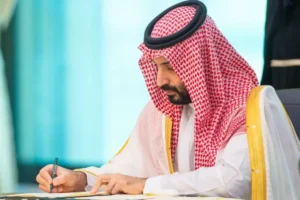
Tehran, MINA – The Saudi Arabian government has offered its condolences to Iran over the death of Supreme Leader Ayatollah Ali Khamenei, who was killed in an Israeli attack on February 28. Messages of sympathy from King Salman bin Abdulaziz Al Saud and Crown Prince Mohammed bin Salman were conveyed to Iranian President Masoud Pezeshkian during the state funeral procession held in Tehran.
The Saudi Foreign Ministry stated that the condolences were delivered by Deputy Foreign Minister Waleed Elkhereiji, who attended as the official representative of the Kingdom. The presence of the Riyadh delegation at the ceremony is seen as a continuation of efforts to normalise relations between the two countries, which were restored in 2023 after years of diplomatic tensions.
The funeral procession for Ayatollah Khamenei is expected to last several days. The coffin, draped in the Iranian flag, was placed at the Grand Mosalla in Tehran, alongside the coffins of several family members who were also killed in the attack. Thousands of citizens have gathered at the site to pay their final respects to the leader who had led the Islamic Republic of Iran since 1989.
Iranian state media also broadcast mass rallies in various cities on Friday evening. Participants held demonstrations, chanting slogans in support of the Islamic Republic and condemning the United States and Israel. The Iranian government estimates that millions of citizens will fill the main streets of Tehran during the peak of the funeral procession, which began on Saturday.
Read Also: Up to 780,000 Protesters Expected Across France Amid Heavy Police Deployment
The presence of the Saudi delegation was one of the highlights of the ceremony. In addition to Saudi Arabia, more than 100 countries reportedly sent official representatives to attend the funeral, including senior government officials, ministers, parliamentary leaders, and envoys from international organisations. Their presence reflects the world’s close attention to Iran’s political dynamics following Khamenei’s death.
Ayatollah Ali Khamenei had served as Iran’s Supreme Leader for more than three decades after succeeding Ayatollah Ruhollah Khomeini in 1989. As the highest authority in Iran’s political system, he held control over the country’s strategic policies, including defence, security, and foreign relations.[]
Mi’raj News Agency (MINA)
Read Also: Adam Hamawy, Gaza Humanitarian Mission Doctor, Elected to US Congress














 Mina Indonesia
 Mina Arabic
 Mina Sport
