





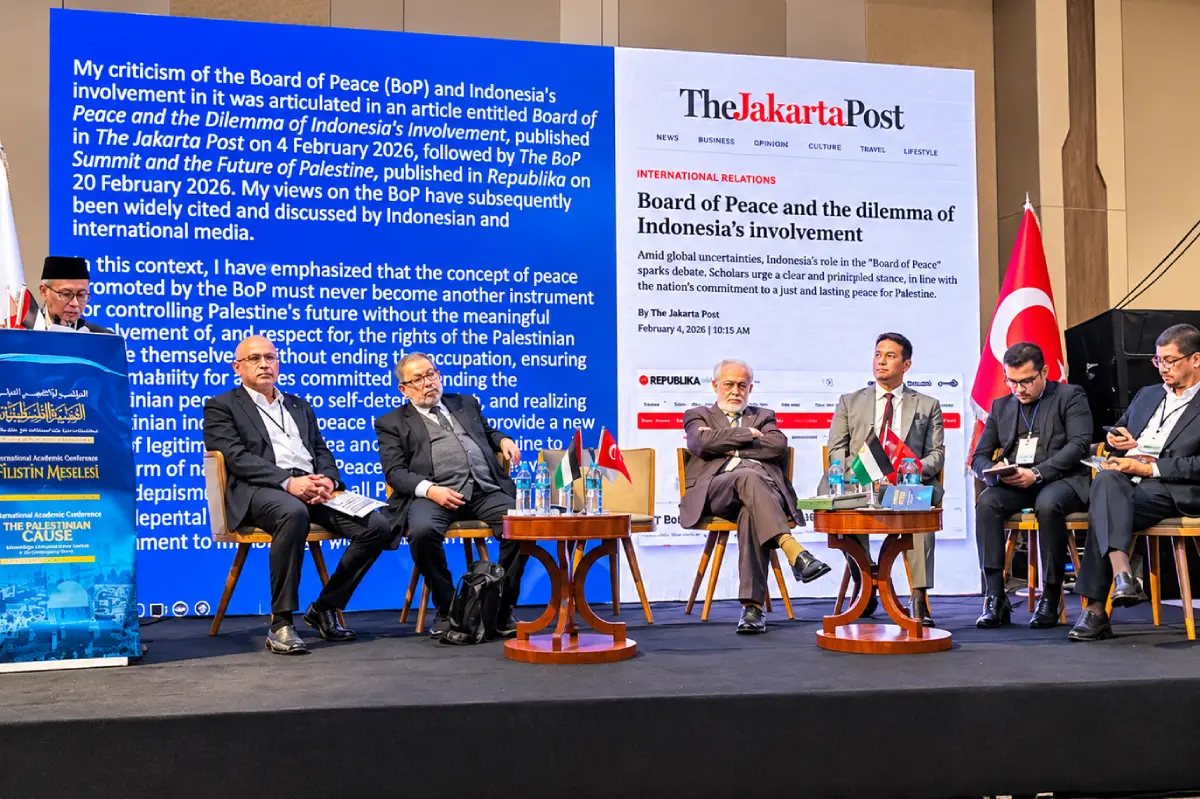

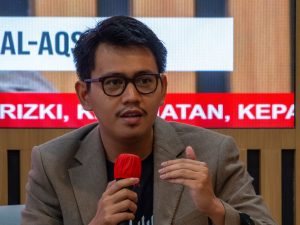
Sudarnoto made the remarks in a speech at the International Forum of Academics for Al-Quds, held in Istanbul, Türkiye on Sunday.
The forum brought together academics and international figures to formulate strategic steps toward the liberation of Al-Quds and Palestine.
In his address, the professor at UIN Syarif Hidayatullah Jakarta said the Palestinian issue was not merely a political conflict, humanitarian crisis or religious matter. Rather, he described it as a fundamental test of human civilization.
“Does the world still uphold its commitment to justice, independence, human rights, international law and human dignity?” Sudarnoto asked in his presentation, titled “Building Knowledge and Awareness, and Transforming Solidarity into Institutional Action.”
Read Also: Bahrain Calls for UN Action and Compensation over Iranian Attacks
He outlined four main pillars that Muslims and the global community should develop to support the Palestinian struggle.
The first is building an intellectual tradition and producing knowledge. Sudarnoto emphasized the moral responsibility of academics to generate knowledge, expose injustice and challenge attempts to justify colonialism and occupation. He said Palestine should become a major concern for universities, research institutions and intellectual communities.
He cited his own contributions through several publications, including Diplomasi Bela Palestina, Diplomasi Total untuk Palestina, Free Free Palestine, and MUI di Tengah Pusaran Krisis Kemanusiaan Global dan Islamofobia. He has also written hundreds of articles for academic journals and mass media, including “Two Years of Al-Aqsa Flood: The Collapse of Israel’s Arrogance and the Rise of Humanity’s Conscience,” published in October 2025.
In the academic field, he has encouraged research into the history and diplomacy of Indonesia’s support for Palestine. He has also proposed establishing an Indonesian Museum of Solidarity and Struggle for Palestine, or a Zionist Genocide Museum, as a public education and historical documentation center.
Read Also: Activists Urge Illinois to Withdraw All Investments in Israeli Bonds
The second pillar is transforming knowledge into public awareness and social change. Sudarnoto, who chairs the Indonesian Ulema Council’s Foreign Relations and International Cooperation division, said knowledge must be widely disseminated to strengthen public awareness. He has used mass media, podcasts, seminars and public forums to communicate his views.
He stressed that supporting Palestine is also a struggle to defend truth and historical memory. Threats to Al-Aqsa Mosque, for example, are not only an issue of religious freedom but also concern historical identity, civilizational heritage and international law.
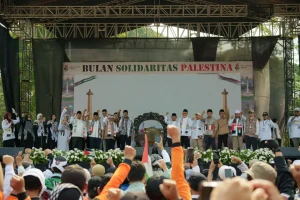
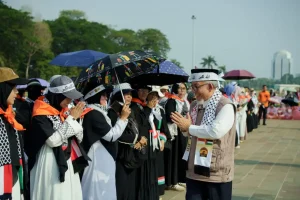
As part of his moral responsibility, he has participated in demonstrations organized by the Indonesian People’s Alliance for the Defense of Palestine (ARI-BP) outside the United States Embassy. During the demonstrations, he called for stronger boycotts of Israeli products and urged the Indonesian government to remain steadfast in supporting Palestinian independence.
The third pillar is turning solidarity into institutional strength and international diplomacy. As AP-CAP president, Sudarnoto has promoted stronger networks among religious scholars, academics, parliaments, civil society organizations and philanthropic institutions at national and international levels.
Read Also: Indonesia Elected to ICAO Council for 2026–2028 After 25 Years
One of his key initiatives was organizing the First Asia-Pacific Conference for Palestine in Jakarta in 2025, which produced the Asia-Pacific Declaration for Palestine 2025.
The conference aimed to establish regional coordination, strengthen international advocacy, facilitate humanitarian assistance and develop sustained institutional cooperation. In 2026, Indonesia was designated as AP-CAP’s headquarters and coordination center, further strengthening the country’s role in international solidarity networks.
The fourth pillar is advocating for a fair and civilized international order. Sudarnoto said the Palestinian crisis reflects a deeper crisis in the international system, marked by double standards in enforcing human rights and the dominance of powerful countries over the fate of weaker nations.
He called for a more democratic, multipolar and just international order that respects the sovereignty of every nation. He also urged fundamental reforms to the United Nations Security Council’s decision-making mechanisms and called for stronger authority for the International Court of Justice (ICJ) and the International Criminal Court (ICC).
Read Also: Irish University Ends Research Partnership With Israel’s Technion After Campus Pressure
“Peace cannot be established without justice. Justice cannot be achieved without respecting human rights, international law and the right of nations to self-determination,” he said.
As a concrete expression of support for the Palestinian people, Sudarnoto also voiced his backing for the international Global Sumud Flotilla movement.
At the end of his presentation, he urged all sectors of society, particularly academics, to build a stronger intellectual and institutional movement for Palestine.
“Universities must produce knowledge. The media must raise public awareness. Religious institutions must mobilize moral responsibility. Civil society must strengthen solidarity. Political institutions must pursue international accountability,” he said.
Read Also: Iran Slams Trump’s Bio-Weapons Claim as Echo of Iraq War Lies
He concluded with a call for solidarity to move beyond emotion and become concrete action.
“Palestine must not live only in our hearts and prayers. Palestine must also live in our minds, our academic contributions, our diplomacy, our institutions and our concrete actions. Let us transform solidarity into knowledge, knowledge into awareness, awareness into a movement, and that movement into sustainable institutional strength,” he said.[]
Mi’raj News Agency (MINA)
Read Also: Houthi Attack on Tower at King Abdullah Financial District Causes Damage, Saudi Civil Defense Says










 Mina Indonesia
 Mina Arabic
 Mina Sport
