





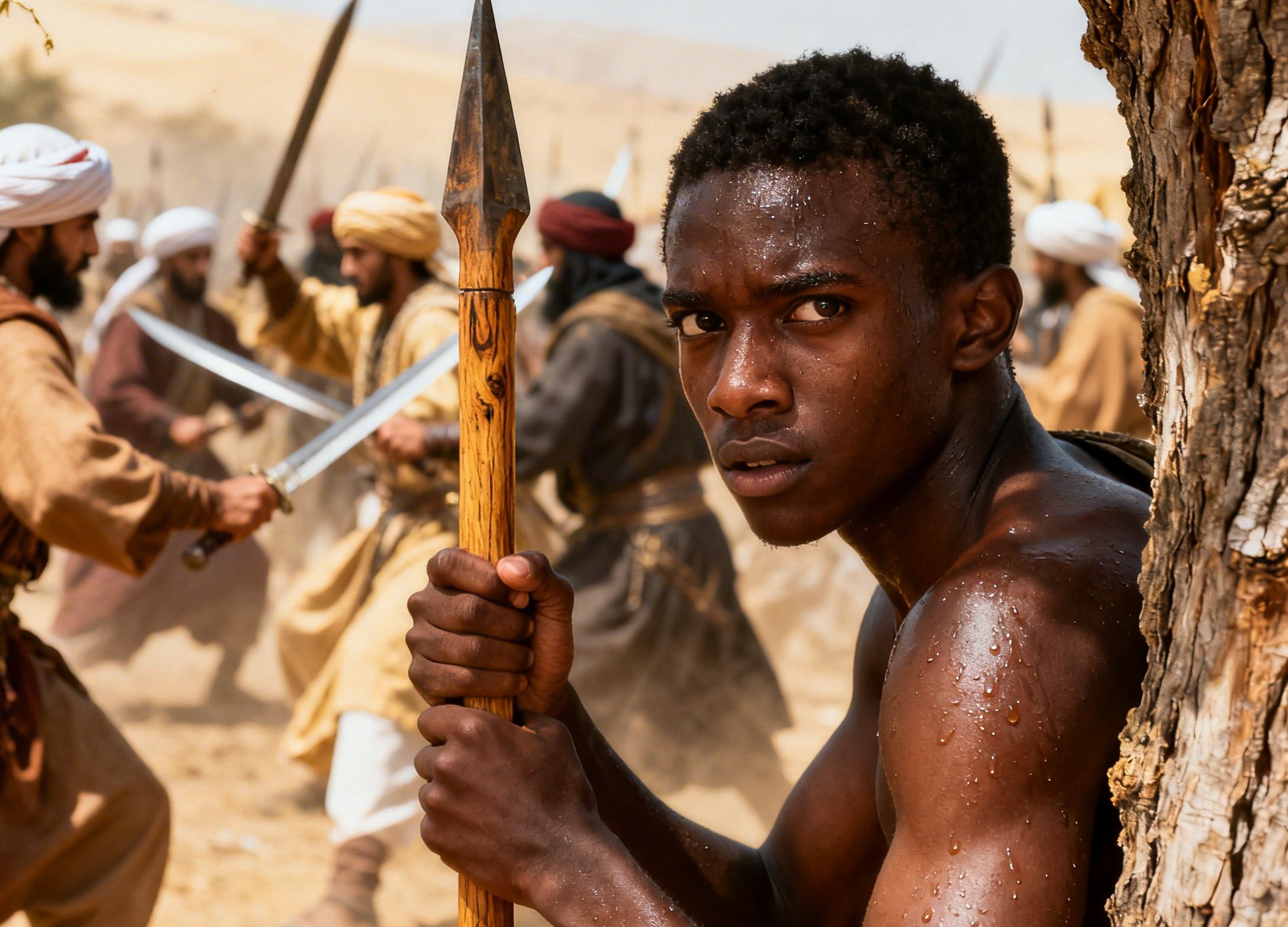

WAHSHI BIN HARB was an Ethiopian slave who killed the Prophet Muhammad’s Sallallahu ‘Alaihi Wasallam uncle, Hamzah bin Abdul Muththalib Radhiyallahu ‘anhu, during the Battle of Uhud.
He was a slave belonging to Jubair bin Muth’im.
Shafiyyur-Rahman Al-Mubarakfury in his book “Sirah Nabawiyah” explains that during the Battle of Badr, Jubair’s uncle, Thuaimah bin Adi, was killed.
Jubair wanted revenge, so he said to Wahshi, “If you can kill Hamzah, the uncle of Muhammad, as revenge for the killing of my uncle, then you will be freed.”
Read Also: Meaning Behind Palestinian Ambassador’s Kiss on Imaam Yakhsyallah’s Forehead
Wahshi was then taken and introduced to Hind bint Utbah, the wife of Abu Sufyan, to be trained, educated, and mentally conditioned.
Khalid Muhammad Khalid in his book “The Characters and Lives of 60 Companions of the Messenger of Allah” explains that Hind herself harbored deep hatred toward Hamzah. According to what people told her, Hamzah had killed her father (Utbah bin Rabi’ah), her uncle (Syaibah bin Rabi’ah), her brother (al-Walid bin Utbah), and her son (it is not specified which son) during the Battle of Badr.
It is therefore not surprising that Hind hated Hamzah intensely. Among all the Quraysh people, Hind was the most active and aggressive in inciting others to fight. Her sole goal was to have Hamzah killed, no matter what the cost.
At first, Hind gave Wahshi the option to kill one of three people: the Messenger of Allah Sallallahu ‘Alaihi Wasallam, Hamzah, or Ali bin Abi Thalib.
Read Also: Remembering the 1969 Al-Aqsa Mosque Arson: A Tragedy That United the Muslim World
It turned out that Wahshi already had character assessments of the three names presented to him. He replied: “I cannot get close to Muhammad at all, because his companions are closer to him than anyone else. As for Ali, he is extremely vigilant on the battlefield. However, Hamzah is very fierce; when he fights, he doesn’t pay attention to his surroundings. Perhaps I can bring him down with a trick or ambush him when he is off guard.”
Hind bint Utbah’s Promise
Wahshi, a former soldier in his homeland, was able to analyze the condition of his future opponents. An agreement was reached that he would kill Hamzah. Hind herself promised him freedom if the mission succeeded.
For days on end, Hind did nothing else but train and incite Wahshi, pouring out her curses, hatred, and anger toward Hamzah, while also planning the role Wahshi would play.
Read Also: Abu Ayyub Al Anshari, the Inspirer of Constantinople’s Liberation
In addition to promising freedom, she also promised to give him wealth and the most valuable jewelry belonging to a woman of her status.
While speaking, her fingers, full of hatred held her high-value gemstone earrings and the gold necklace wrapped around her neck.
Then, with eyes blazing with passion, she said to Wahshi: “If you can kill Hamzah, all of this will be yours!”
No matter what, Wahshi was tempted by the offer, and his imagination soared with longing to quickly face the upcoming battle.
Read Also: Sa’ad bin Abi Waqqash, the First Islamic Archer and Inhabitant of Heaven
He envisioned his spear piercing Hamzah’s body, so he would no longer be a slave. He also longed to soon possess the jewelry that had been adorning the neck and fingers of the wife of a leader and daughter of a prominent Quraysh figure.
Day after day passed, and as the time for battle drew closer, Wahshi prepared himself to go to the battlefield.
Wahshi’s Story
During his early days as a Muslim, when he was still shunned, Wahshi recounted: When the Messenger of Allah conquered Makkah, he fled to Ta’if. However, when the delegation from Ta’if came out to embrace Islam, Wahshi became extremely worried about his safety.
Read Also: Reading 8th Indonesian Islamic Congress’ Taujihat Through the Lens of Ulul Albab
“I went to Sham, Yemen, and other countries. By Allah the Almighty, at that time I was very afraid. Suddenly someone said: ‘By Allah the Almighty, if Muhammad Sallallahu ‘Alaihi Wasallam wants to kill someone, that person immediately enters his religion (to be safe),’” Wahshi told the companion who asked him to share his story.
Wahshi then came out of hiding and went to Madinah to meet the Messenger of Allah Sallallahu ‘Alaihi Wasallam.
The Prophet Sallallahu ‘Alaihi Wasallam asked, “Are you Wahshi?”
Wahshi replied, “Yes.”
Read Also: Once Again, Indonesia-Palestine Relations
The Prophet (Sallallahu ‘Alaihi Wasallam) said, “Sit down and tell me how you killed Hamzah.”
Wahshi then narrated: “I was previously a slave of Jubair bin Muth’im. His uncle, Thuaimah bin Adi, was killed in the Battle of Badr (by Hamzah Radhiyallahu ‘anhu). My employer (Jubair) said to me, ‘If you manage to kill Hamzah, you will be free.’
I was skilled with the spear; very rarely did my spear throw miss its target. I went out with some people (in the Battle of Uhud). When the two armies met, I took my spear and moved forward until I saw Hamzah Radhiyallahu ‘anhu among the crowd. He looked like a grayish camel. He was threatening people with his sword and never let it go. By Allah the Almighty, I had prepared myself to fight him, but suddenly as-Siba bin Abdul Uzza al-Khuzai went ahead of me. When Hamzah Radhiyallahu ‘anhu saw him, he said, ‘Come here, O son of a circumciser woman.’ Then Hamzah Radhiyallahu ‘anhu beheaded him. By Allah, his head did not miss the strike. I have never seen anything faster than the fall of that head. Then I moved my spear, and when I was absolutely sure, I threw it. My throw hit the lower part of his abdomen and came out between his legs. He tried to get up but could not. I waited until he died, then I stood in front of him, pulled out my spear, returned to the army, and sat down.”
After hearing Wahshi’s story, the Prophet Sallallahu ‘Alaihi Wasallam said, “Woe to you! Get away from me. Do not appear before us!”
Read Also: KUII For Whom? A Critical Reflection on the 8th Indonesian Muslim Congress
“This shows the love of the Messenger of Allah Sallallahu ‘Alaihi Wasallam for his uncle, Hamzah Radhiyallahu ‘anhu. I stayed away from him until he passed away.”
Thus, after embracing Islam and meeting the Prophet, Wahshi never appeared in any place where the Messenger of Allah could see him, even though he had become part of the Muslim community. []
Mi’raj News Agency (MINA)
Read Also: Football, Religion, and Solidarity with Palestine





























 Mina Indonesia
 Mina Arabic
 Mina Sport
